

It’s the routines we do most that we think about the least. Such as bathing. Whether you use a shower or a bathtub, most of us are likely past the point of conscious decision-making when it comes to getting clean. It’s something we just do.
But as with all things, there are some best practices and aspects to pause and consider. Let’s take a look at a few of them, and perhaps just a small adjustment will help you make the most of your cleaning routine.
Table of contents:
- How often should you shower?
- Which is better: a shower or a bath?
- Showering and your skin health
- How often to wash hair
- Best time of day to shower or bathe
- Ideal shower length
- Best order of body washing
- Which is best: Washcloth, loofah, brush, poof, or hands?
- Which cleanser to use
- Where Dr. Bronner’s fits into the discussion of bathing best practices
- How to get the most out of your bathing routine
- Putting it all together: My personal shower routine
Quickest tip to a better shower (TLDR)
Shorter & Cooler – A shorter shower at a lower temperature is better for your skin (by not stripping oils and nutrients) and better for the earth (by using less water and energy to heat it).
How often should you shower?
Body type, lifestyle, and environment makes the answer different for everyone, but in general, current American norms lean towards bathing too often rather than not often enough.
Expert recommendations range from bathing every day to every other day. Very few people need to shower more than once a day. Finding the balance that’s best for you involves the following considerations:
- Lifestyle – more active, on-the-go days might point to a need to shower more often.
- Occupation – jobs that entail greater physical activity or outside work require more bathing than indoor desk jobs.
- Exercise – vigorous exercise increases the need to wash off sweat and other secretions.
- Season – in dryer, cooler winter months your skin may not need as frequent of washing.
These factors change over the months of the year and the years in our lives. The best way to tell is to use your senses: Balanced skin feels elastic and smooth but not oily, looks fresh, but not shiny or dull, and smells neutral.
Which is better: a shower or a bath?
I’m well aware that wading into this topic of shower vs. bath is likely to spark strong emotional reactions, so before I set you off, I’ll tell you my bottom line: There is not a “better” with taking a shower versus a bath. There are pros and cons either way.
- Ecological considerations: It is possible to conserve water equally well in a shower or a bath. It is also possible to use copious amounts of water in both a shower and a bath. Let me walk you through some math. A deep soak in a bathtub or a long shower both use copious amounts of water. A half full standard 5-foot bathtub would use about 32.5 gallons of water, while a 15-minute shower with a standard flow of 2–2.5 gallons of water/minute uses 30–37.5 gallons. That’s about the same for both. On the flip side, a bath that’s filled with only 3 inches of water would use about 14 gallons, and a speedier 8-minute shower would consume 16 gallons. Knock off 2-ish gallons for every minute you can reduce that.
- Skin impact: Water strips our skin of its protective barrier. The hotter the water, the more it strips. A shorter, cooler bath would be gentler on our skin than a longer, hotter shower. Conversely, a shorter, cooler shower would be better on our skin than a longer, hotter bath.
In the shower vs. bath debate, it comes down to personal happiness. If a shower or a bath does great things for your spirit, your mental relief, and your overall well-being, go with that. For least impact on skin and earth, use less water in the tub, take a shorter shower, and keep the water warm but not hot.

Showering and your skin health
Our skin builds up a natural barrier to protect itself against the dual threats of environment and germs. This barrier is composed of sebum, an oily substance our skin produces, combined with a healthy microbiome, made up of the many microorganisms our skin relies on to combat intruders.
Cleaning our skin, by definition, washes this barrier off, but it takes only an hour or two for healthy skin to replenish it. If we shower or bathe too often, or cleanse our skin too vigorously, our skin may fall behind in producing what’s needed, leaving skin dry and vulnerable to cracking. Alternatively, our skin may surge into overdrive and produce too much, clogging pores with excess sebum and causing an oily feel.
This takes us back to my point: Read your skin. If it is unbalanced, make an adjustment to the frequency, the cleanser, or how you scrub yourself.
How often to wash hair
As with bathing in general, how often to wash hair varies by individual. However, most people wash their hair too often. Instead of washing your hair based on the day of the week, wash your hair based on the feel and look of your hair. Healthy hair is fueled by the natural oils our scalp produces, and every time we wash our hair, our scalp has to start over.
While it certainly is necessary to remove the buildup of oils and product, which can hold on to dirt and weigh down our hair, don’t do this too often. Few people need to wash their hair every day. Factors that lean to more frequent hair washing include shorter hair, straighter hair, oilier scalps, and more active lifestyles.
Instead of washing your hair based on the day of the week, wash your hair based on the feel and look of your hair.
Again, read your hair—not the calendar. If your hair is strong and healthy, not dull or prone to breakage and not excessively oily, whatever you’re doing is working for you. Keep doing that. If you have been struggling with dry hair, breakage, hair loss, or itchy scalps, one of the first steps to take is to reduce the frequency of washing it. For some people, that may mean only washing their hair once a week. When hair remains off-balance, consider a scalp scrub or a hair masque.
Best time of day to shower or bathe
Despite ardent supporters on each side of this debate, there is no definitive answer to the best time of day to shower or bathe. Those who prefer a morning shower will benefit from washing off the secretions and bacteria that collect on our skin overnight, and clean morning skin will stay fresher throughout the day. However, those in the evening shower camp will be glad to hear there are acknowledged benefits from washing off the dirt and sweat from a day’s activities, especially for more active outdoor occupations and lifestyles. Also, it is a good idea to remove products like makeup, sunscreen, and bug spray at the end of the day so that they don’t clog pores overnight. (One thing experts agree on is that sheets need to be washed at least once a week, or more if you share your bed with pets.
Ideal water temperature for a shower or bath
While warm and cold water both have their benefits, hot water is not recommended by dermatologists. To begin with, hot water is damaging to skin, stripping it of more of its protective oils and, at the extreme, scalding skin. On the environmental side, hot water uses more resources to heat. Lastly, to bust a myth, hot water is not more effective at removing germs from our skin. According to the Environmental Protection Agency, water must be 160°F (71°C) to kill germs. Hot water will begin to scald skin at 120°F (49°C).
A shorter shower at a lower temperature is better for your skin (by not stripping oils and nutrients) and better for the earth (by using less water and energy to heat it).
The ideal temperature for a shower or bath is just a few degrees above normal skin temperature, or between 98°F (37°C) and 104°F (40°C). If your water easily fogs up your mirrors, it is likely too hot.
The benefits of a cold shower
Before you begin to think either more or less of me for this suggestion, I want to share that I do not take cold showers. But maybe my research here will convince me. Some of the benefits of a cold shower include improving circulation, skin vibrancy, and mental clarity; relieving muscle soreness and skin irritation; increasing the activity of the metabolism and the immune system. And it may just boost your mood, according to one study—or at least getting out of the cold shower would!
Soap works equally well in warm vs. cold water. Soap is not dependent on water temperature for the micelle formation it relies upon to work, so this decision is not a matter of whether you’ll get clean. If jumping straight into a cold shower cold-turkey (couldn’t help myself) is beyond what you can handle, consider gradually lowering the water temperature over a few shower cycles.
Ideal shower length
Each minute that you are in the shower or bath removes more oils from your skin and uses more resources of water and heat. A five-to-eight-minute shower is considered long enough to get clean without overly stripping the skin or utilizing resources.
Best order of body washing
Research supports a top-down approach to body washing. Not only so that areas washed first don’t get dirty again while other areas are washed, but also so that cleansers are fully rinsed off.
- Get the water to the ideal temperature and then wet your body before beginning washing.
- Begin with hair washing, if this is a hair-washing shower. Wash hair, focusing on the scalp where oils and product build up. Spend less time washing the ends of your hair where hair is generally less oily. Rinse shampoo out. Condition hair, if that is part of your routine. Rinse it out.
- Then wash your face, and rinse.
- Move on to the body, washing from neck to toe. Then rinse.
- Do a final rinse with cooler water. This will encourage blood flow, tighten pores, and reduce skin sweating so that your shower’s effects last longer.
Which is best: Washcloth, loofah, brush, poof, or hands?
Choosing the right tool for your shower or bath makes a big difference in skin health and integrity. Our hands are the gentlest “tool” for skin washing and provide perfectly fine cleansing action. However, a tool can help you hold on to soap and create a richer lather. A washcloth or natural loofah are better for skin health and the environmental than synthetic options. Both washcloths and loofahs help to lather up soap into satisfying bubbles and are effective at cleaning skin.
Plastic poofs not only are not sustainable to produce or dispose of, they also difficult to keep clean and shed microplastics. Brushes in the same way are hard to clean and less sustainable to produce or dispose of.
Are loofahs good for your skin?
Natural loofahs (sometimes spelled “luffa”) are one of nature’s most interesting fruits. They are a type of squash, similar to a zucchini, but when left to dry on the vine, they form a network of strong fibers. They then can be peeled and sliced into a useful, sponge-like cleansing tool.
Of the bathing tools I’ve mentioned, loofahs are more exfoliating. They might be too rough for sensitive or delicate skin, but if tolerated can be an excellent way to exfoliate and cleanse skin. They also are sustainable, renewable, and biodegradable.

How often to clean your washcloth or loofah
Moist surfaces are a breeding ground for microorganisms. Any tool you use in the shower needs to dry quickly and fully in between use. Leave tools in a spot where they are not sitting in water and air flow will dry them quickly.
Anytime a tool smells musty, or worse, shows any mold, it should be replaced. The universal recommendation is that washcloths should be replaced with a clean one after each use or used only twice at the most. A natural loofah, with its open structure that dries more readily can last 3-4 weeks.
Washcloths can be cleaned in your washer’s hot cycle, and natural loofahs can be tossed in your compost bin or yard waste container.
Which cleanser to use
Bar soap vs. liquid soap; shower gel vs. body wash
When choosing body care products, it’s a matter of looking for ingredients that are best for skin and lack harmful side effects. Because of lax controls on ingredient safety, we have to monitor ingredients ourselves. This means reading ingredients and avoiding formaldehyde releasers like quaternium compounds and ureas, hormone disrupting parabens, and undisclosed “fragrance” which can hide a whole host of allergens, reproductive toxicants, and carcinogens.
There is no need for regular use of antibacterial shower washes. Overuse of antibacterial agents can reduce their effectiveness when truly needed and deprive our skin of the necessary microbiome it relies on to combat harmful bacteria and other germs.
Once you’ve looked for good ingredients and the lack of antibacterial agents, the choice of product comes down to ease and preference. Bar soap offers the benefit of a more concentrated, cost-saving product with less packaging. Liquid soap offers the benefit of quicker application. Products labeled as shower gels and body washes rely on synthetic detergent cleansers, which need closer monitoring of ingredients for safety.
While advertisers will tell you that you need a different cleanser for each part of your body, this is not necessarily true. One simple, versatile cleanser can clean the whole body. This reduces time spent showering, clutter on the shelves, and cost in the grocery basket. Using one product is also a lot less to think about in the morning.
What to use on sensitive skin
Sensitive skin is skin that is easily irritated, turning red or perhaps swelling. It is best to wash sensitive skin with simple, fragrance-free cleansers. Use ingredients with fewer ingredients to reduce the chance for irritation. This will to make it easier to identify the source of any irritation if it does arise. Be sure to avoid undisclosed “fragrance” in an ingredient list as they can be made up of a mixture from more than 3000 possible individual ingredients, with a high concentration of allergens and irritants. Each fragrance blend commonly contains 30-200 different ingredients, which can be too much for sensitive skin to handle.
What to use on the face
The skin on our faces is more delicate and should be washed with care. That does not mean, though, that a separate facial cleanser is necessarily needed. One product can be used head to toe, so long as that product is mild enough for the face. While every skin type is different, if your facial skin is sensitive and prone to redness, take care to avoid aggressive cleansers that may strip too many oils from the facial skin. Also avoid not only artificial fragrances that often cause irritation, but even essential oils that can be too stimulating for facial skin. Menthe arvensis, a type of mint oil with a particularly high menthol content, might overwhelm sensitive facial skin. A gentle, unscented or mildly scented option may be best for facial skin.
Also take care not to over-scrub your face. The delicateness of facial skin means the rough washcloths or any sort of tool may be too much. The best way to wash your face is with your hands, using gentle, circular motions. Rinse skin well, and pat dry.
Recommendations for bathing newborns and babies
Because baby skin is more delicate and sensitive, they may benefit from following the recommendations for sensitive skin. Since bathing removes the skin of its natural oils, babies only need a full bath every 3-4 days, and only with lukewarm water. A wipe down with a soft, wet cloth may be all that’s necessary on non-bath days. Even during a full bath, particularly sensitive skin like the face should be cleansed only with water.
When it comes to cleansers for babies, since the undisclosed “fragrance” in an ingredient list contains so many unknowns and the frequent possibility of sensitizing or hormone disrupting ingredients, opt for either fragrance-free or simple fragrances such as from mild essential oils.
Baby hair has a different structure than adult hair. It does not have the outer cuticle layer that adult hair has. Many babies lose the hair that they are born with, which is a natural result of developing hormones and not a sign something is wrong. (Consult your medical professional if you suspect something may be wrong.) Because baby hair is finer and more delicate and because baby scalps don’t produce the same amount of sebum as adult scalps, it does not need frequent washing. Washing hair once a week with the general skin cleanser you are using elsewhere is often all that’s needed for their hair. Keep all products out of babies’ eyes.
Sometimes features that are marketed for babies, such as being tear-free, can distract from other problems in the formulations, so be sure to read ingredients. As well as avoiding fragrances, avoid any parabens (a class of preservatives, some of which are associated with endocrine disruption), pH adjusters like DEA or TEA (can be used to neutralize pH but are toxicants and under scrutiny as carcinogens), and quaternium compounds or ureas (which release formaldehyde, an irritant, allergen, and known human carcinogen).
Recommendations for bathing toddlers and young children
Even as they leave babyhood behind and enter childhood, it is particularly important not to expose their developing systems to hormone disrupting ingredients which are all too frequently found in fragrance. As kids learn to bath themselves, they are likely to have a more successful bathing experience if products are simple. Handing them one simple head-to-toe product is a good option.
One simple, versatile cleanser can clean the whole body.
When it comes to bath frequency for children, while their skin is more resilient than babies’, they still may not need daily bathing. If a day has been particularly active, or any sunscreen or bug spray has been applied, this should be washed off before sleeping.
Children’s hair develops at many different paces. Eventually their hair will develop the outer cuticle of adult hair and they will need to adopt a different hair care routine. This typically might occur around age 3-4, but can certainly happen earlier or later. Judge when the hair starts to become coarser and harder to detangle.
One thing to consider, products with peppermint and eucalyptus essential oils are not recommended for children under 3 years of age as these scents may be overwhelming for them.
Recommendations for bathing elderly skin
Elderly skin has often lost its elasticity and does not produce the same levels of sebum as younger skin. This means it definitely would benefit from less frequent bathing. Use a mild cleanser with no irritants and be sure to moisturize afterwards.
Where Dr. Bronner’s fits into the discussion of bathing best practices

I can hardly talk about showering and bathing without mentioning where Dr. Bronner’s products, my family’s line of products, fit into this discussion. Dr. Bronner’s makes several different soaps to fit different needs and preferences. There’s the classic Pure-Castile Magic Soap, known for its smooth lather, refreshing scents, and clean rinse. It’s a simple, versatile true soap that I use head to toe, even for my face and hair. Pure-Castile also comes in a Magic Bar Soap version, which my husband uses head-to-toe in Almond. Then, there’s the Organic Sugar Soap, which is a boosted version of the Castile, with added shikakai powder, sugar, and white grape juice, providing a creamy lather and sweet aroma. One step up from that is the Organic Shaving Soap, which is a thicker version of the Sugar Soap that develops a rich lather and provides a close, comfortable shave.
How to get the most out of your bathing routine
A few final notes for maximizing your experience in the shower or bath:
- Do a final rinse with lukewarm or cool water to remove any cleansers and tighten pores.
- Dry skin with by patting or lightly rubbing.
- Apply moisturizer within a few minutes of drying off in order to lock in moisture.
A greener, more sustainable shower routine
Here are five easy ways to green up your shower routine.
- Take quicker, lower temp showers that reduce the use of water and energy resources.
- Use products that are sourced from renewable and sustainable sources and are biodegradable.
- Use products that come in sustainable packaging that is refillable, biodegradable, compostable, or recyclable. Buy in bulk or purchase from zero-waste stores that refill the bottles you bring in.
- Capture the water used while you’re waiting for it to warm. Keep a bucket handy and use the water to water plants, refill the dog bowl, or wash a car.
- Avoid using single-use wipes, which generate waste and often are coated with less than ideal ingredients. Despite what the packaging says, they are not flushable in either a sewer or a septic system.
Seven common showering and bathing mistakes
- Bathing too often.
- Washing hair too often.
- Using too hot of water.
- Staying in the bath too long.
- Waiting too long to moisturize skin afterwards.
- Not swapping towels and washcloths for clean ones often enough.
- Not cleaning or replacing loofahs and brushes often enough.
Putting it all together: My personal shower routine
Here’s how my morning shower goes:
- Get wet all over. Open my bottle of Magic Soap (usually Almond or Citrus), take one deep breath to focus on the scent and ground myself in the present.
- On hair washing days, usually every third day, I start with that: A half tablespoon of the Magic Soap is enough for my long hair. I lather it through. After thoroughly rinsing out the soap, I dilute lemon juice by half in a cup and then pour it over my head, work it through, and rinse thoroughly.
- Face comes next. Add 2-3 drops Magic Soap into my wet hands, lather it up, and massage into face. Rinse.
- Body is last. I apply a small squirt of Almond Magic Soap on a wet washcloth and wash from neck to toes. I don’t pre-dilute the soap, as I find the water present in the situation does the diluting for me.
- Rinse well with cool water, then dry off.
There are special days when my hair or skin needs a little something extra. In those cases, I may apply a hair masque or a scalp scrub. I may use one of my GIY Body Scrubs to exfoliate dry skin. But most days, it’s just me and my one soap. Life is complicated all on its own. My shower doesn’t have to be.
Frequently asked questions
How often should you wash your hair?
This changes for every person, but generally, you should not wash your hair every day. Evaluate your hair needs, and if it is dry or breaking, reducing your washing to every 3-4 days.
How frequently should you shower?
The general recommendation is either every day or every other day.
How long should a shower take?
Five to eight minutes is an ideal shower length.
What temperature should a shower be?
The ideal temperature for a shower or bath is just a few degrees above normal skin temperature, or between 98°F (37°C) and 104°F (40°C).
How do you bathe a newborn?
Wash newborns every 3-4 days, using lukewarm water, a soft cloth, and a simple cleanser that is unscented or mildly scented with essential oils. Use only water on the face.
Further reading
- I Wash My Face with Castile Soap
- 12 Personal Care Ingredients to Avoid
- Liquid vs. Bar in Dr. Bronner’s Castile Soaps
- How to Shave with Dr. Bronner’s
This use and many more are in my book, Soap & Soul: A Practical Guide to Minding Your Home, Your Body, and Your Spirit with Dr. Bronner’s Magic Soaps, available now in hardback on DrBronner.com or at your favorite bookseller, and as an eBook and audiobook (read by me!) from wherever you download or listen.
Originally published in October, 2010.







I am new to the product, and can’t wait to receive an order in the mail. My 18 year old daughter is having an issue with her underarms. When out of the shower for 5 mins she already has underarm BO. She was researching the internet for anything that she could find that helps with that issue…tried just about everything….different brands, strengths, liquids, bars, fragrance, non-fragrance and the different ways to apply.
NO SUCCESS!! she learned of your product on YouTube…She bought a bottle of the liquid soap and we both cannot wait to see the results…I am ecstatic about all the different uses and can’t wait to try it out on them all.
Hi Jaclyn- Welcome to the Dr. Bronner’s family. I hope the soap works for your daughter. Feel free to reach out with any questions.
I have one toe nail that has fungus. It is very thick, I have read that tea tree oil ( or the soap)? Will help. Do I just use the soap right out of the bottle to clean the nail? I have not found any instructions on using the soap for nail fungus Thank you for your help.
Hi Joyce- Fungal infections can be so tough to cure. I have not heard of Tea Tree Castile Soap as a treatment for this particular use, and pure essential oils applied directly to skin can cause burns or irritation. Please confer with your medical provider for advice.
I started swimming 5 days a week for the first time and during the cold season. My skin is drying and itching all thru the day. Will your products remove the chlorine from my skin?? I’m 65, and I’ve never experienced this before. I have considered giving up swimming to save my skin. Please HELP!!!!!!
Hi Deitra- Oh goodness! I know that dry, itchy feeling! When it’s particularly dry, as it can be this time of year in Southern California, I use our Organic Shaving Soap. It is the most moisturizing of our soaps, with the Organic Sugar Soap as a close second. Both are formulated with organic white grape juice and organic sugar, humectants which draw moisture into the skin, and also Organic Shikakai powder, which is known for its ability to nourish skin and hair. I think you’ll find this blog post on the “moisturizingness” of our soaps helpful: https://www.lisabronner.com/warding-off-dry-skin-with-dr-bronners-soaps/ I also find coconut oil to moisturize and soothe dry skin. Apply a small amount of coconut oil (a little goes a long way) after swimming and showering. If you use too much coconut oil, it will stay on the surface of the skin and get clothing or bedsheets greasy, so be sure to use just a bit.
Dr. Bronner’s liquid soaps are very alkaline. If you’re not familiar with this, it means your hair will get very clean, but also very dry and brittle despite being wet. It’s as if you washed your hair with a mild glue. To successfully wash hair, namely on your head, you must have (a) this compatible rinse OR a diluted solution of ACV & water. You will seriously be amazed after rinsing with a DIY solution of 25% apple cider vinegar and 75% water. You can adjust the rinse from there, if more softness is desired. It’s amazing how well this works. My hair (medium-length men’s dark brown hair) is regularly dry as I live in SW Colorado. The ACV rinse is required and strong. When I’m in the Adirondacks where the humidity is much higher and the water softer, the rinse is still very necessary, but much weaker dilution. It’s a cheap experiment. We all have ACV in the cupboard. Put it in a used water bottle with a pull-up squirt cap or just in a glass jar. Drizzle 1/4-1/2 cup over washed hair (while in shower). Spread it around. Let it sit a few minutes. Bam! Soft, manageable, clean, fresh, hydrated hair. Good luck.
Hi George- Thanks for sharing your experience!
Hey,
Question: Is it possible to dilute the liquid castile soap to -> 50/50 water/liquid castile soap in like a squirt bottle – to be kept in the shower and squirt that into a louffa/sponge/cloth ? Or should it be used straight as is ? I find I end up using too much like a table spoon – instead of a few drops. Best…-scatterbrainz
Hi Scatterbrainz- I don’t because dilutions are usually cold (and I’m a wimp), but you sure can! You can probably get by with less soap, but tinker with that dilution to find what you like best.
Another page on your site links to this one as if this will contain the instructions on how to actually dilute your soap.
But it doesn’t.
Please add the actual “dilution cheat sheet”. Now all these posts just read like advertisements.
Hi Jukka- Here is a direct link to all of the cheat sheets: https://www.lisabronner.com/category/drbronner-products/cheat-sheets-and-recipes/ I’m sorry to hear its difficult to find the dilutions cheat sheets. We’re making some improvement to the site that should remedy that in the near future.
Can you use this on your lady parts
Hi Kim- Yes, Castile Soap is safe for sensitive areas. Peppermint Castile can be intense, whereas the Unscented is an extra gentle option.
Hello! I’ve been switching to natural products lately and I’m very excited to have discovered your brand. I got the Pure Castile Soap (Almond) and it smells divine!
However, I’ve been seeing a lot of comments about people insisting that it HAS to be diluted, otherwise it will cause a rash etc .
So I figured who better to ask than the company itself.
Do I HAVE to dilute it for use as body wash or hand wash etc?
Or is it safe to use as is, straight out of the bottle?
Thank you!!
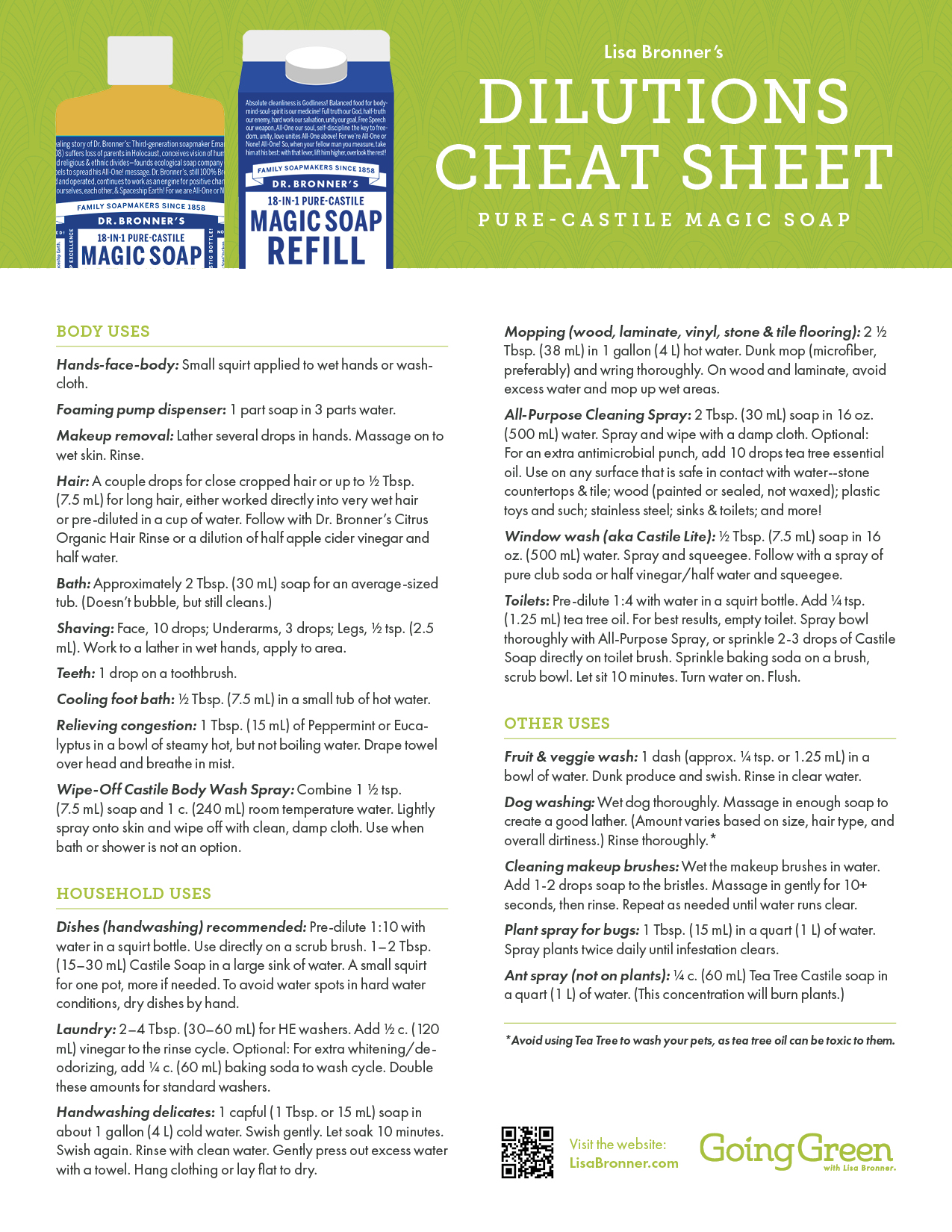
Hi Olga- Welcome to the Dr. Bronner’s family! I wet my face, hands, hair, and body before using. The water present in the situation takes care of the diluting with no effort on my part. For more details on usage, here’s my Castile Soap cheat sheet: https://www.lisabronner.com/dilutions-cheat-sheet-for-dr-bronners-castile-soap/
Hello, I’m looking to make the switch in our household and I’m trying to choose the best soaps for my husband, children (ages 16,7 and 4) and myself. Any recommendations?
Also, what do you recommend for kitchen/floors?
Hi Koreyah- Welcome! For personal use, try the Pure Castile Liquid soap. This is our original, most popular, and my favorite soap. For scent, to meet the preferences of a variety of ages, try one of the mellower scents like Almond. This is also my favorite (along with Citrus). There is the zestiness of the Peppermint, but not all kids like that. Then there are the floral, but guys may not go for that. Almond is a great crowd-pleaser. You can use the Castile for a bunch of different things. Start with just general body and hand washing, but then give it a try for other uses from my Cheat Sheet (https://www.lisabronner.com/dilutions-cheat-sheet-for-dr-bronners-castile-soap/). For cleaning kitchens and floors, you can’t do better than the Sal Suds. It is amazingly versatile and effective. Dilute 1 Tbsp. in a 1 quart of water in a spray bottle for All-Purpose Cleaning. Use 1 tsp. per gallon of water for mopping.
I am looking for a substitute for the orange ‘Gojo’ type soap that my husband uses when he works on the car. Can he use this straight on his hands? Will it cut the grease? Thanks!
Hi Katherine- The Castile can be used straight on the hands for intensely greasy situations, but if the automotive grease is too much, I would try the Dr. Bronner’s Sal Suds All-Purpose Cleaner (1 Tbsp Sal Suds in a quart of water). I have not found a grease that Sal Suds can’t handle.
Hello! I used the peppermint soap and I loved it! However my female parts didn’t. Felt like it swallowed an altoid. I obviously didn’t use it directly down there, but in the shower it drips all over your body when rinsing and washing. Did I maybe put too much on my rag or something? Would it help if I diluted it before I got in the shower in a seperate bottle? Because it was not fun.
Hi Heather- The Peppermint Castile is pretty intense, and a little bit goes a long way. Our Unscented is the most gentle for delicate areas.
Hi, are the liquid soaps safe to use in the vaginal area? Specifically the Unscented ( Baby blue ) one.
Hi Jania- Yes, Castile soap is safe for sensitive areas. The Unscented is an extra gentle option.
I’ve heard that using the Dr B’s peppermint soap as a body wash helps keep bugs and mosquito bites away. Any info on this would be great. Forgive me if this has already been asked.
Cynthia
xoxo
Hi Cynthia- While Peppermint is a great natural deterrent to mosquitos, it might not be enough to keep them at bay if they are really swarming and are intent on eating you. But they are attracted to our sweat and smells, so showering with it couldn’t hurt. I’ve also found the Peppermint Castile to be very relieving to itchy bug bites afterwards.
Hi there, I’m looking for a ‘green’ shower screen cleaner and was wondering if you know whether the GIY Soft Scrub would be suitable? 🤞Love your products.
Hi Janine- If it is glass, yes it would scrub off water spots, soap scum and the like. You can test it on an inconspicuous spot.
Hello, there are lots of baby shower and shampoo 2-in1 products in the markets said soap free and tear free, and we can simply add a bit in a small bathtub of water to clean baby without further rinsing with water again, which is easier to handle with a little baby. Can I do the same with this Baby Unscented Pure-Castile Liquid Soap? Just add little bit in a bathtub of water to clean my baby without further rinsing with water afterwards? Will it be harmful or simply not clean to leave some residual soap on baby? Thank you very much
Hi Nicole- Yes, rinsing with the bath water is sufficient. Keep in mind, no true soaps are tear-free, so take care to keep out of your little one’s eyes.
Are these soaps non-comedogenic?
Hi Mayra- The soaps do not clog pores. Pores are clogged by products that leave behind certain residues on the skin, usually done in the name of moisturizing or smoothing the skin. The Castile soaps are very clean rinsing. You need to give your skin two weeks to acclimate to them before deciding on their efficacy. I found when I first switched that I had a slight increase in breakouts, but then my skin was clearer and smoother than it had been in years. My guess is that the soap was really digging stuff out of the pores. Be a bit wary of labels that make “non-comedogenic” claims as this word is not regulated. Anyone can say it about any product.
so i purchased the 18 in 1 hemp and peppermint liquid soap and i did’nt notice the dilute part until after and just poured into my bath water while the water ran.. my skin felt great afterwards but i wonder are there any negative effects that could’ve caused by not diluting?
Hi Bianca- There’s no need to dilute the soap before adding it to bathwater. It will get diluted plenty there! As I’m sure you noticed, a little bit of our soap goes a long way.
Hi since the Castile baby soap has double the amount of olive oil does this mean my skin or surface I clean on become more oily to the touch?
Hi Javen- In our Unscented Castile, the essential oils are replaced with the extra olive oil. This makes for an extra nourishing soap. But our soaps do not contain any relevant amounts of the actual oil. Rather, the oils are “saponified”, that is, through a chemical reaction they are turned into soap with very different physical and chemical properties than oil.
Hi Lisa,
I just got my hands on a couple small bottles of the 18-in-1 soap. I want to use it in the shower in a squeeze bottle, as my teenager will drain it quickly (he won’t adhere to three drops on a washcloth, etc.). What would be a reasonable dilution? It would also be used as a shampoo of sorts. Note, this is all I have. I don’t have any of your other products nor have access to them.
Second question, does this soap has any sanitizing properties? At this time that’s a question we’re all thinking about in everything we do?
Thanks.
Hi Jerry- I hope you don’t mind that I’ve combined both your questions here. Using a smaller amount of our soap can take some getting used to! A foaming pump dispenser will help control the amount of soap your son uses. It adds air and gives volume to the soap. Use a ratio of 1 part soap to 3 parts water. In squeeze bottle, use a ratio of 1:5 and adjust if needed. For hair, use about 1/2 tsp. soap and work into wet hair. Follow with an acidic rinse of 1/2 water and 1/2 apple cider vinegar. Having said that, my husband and son both have short hair and simply wash-and-go, without the acidic rinse. Soaps, including our Castile Soap, work effectively by attaching to dirt, germs, and grime and rinsing them away, leaving clean surfaces – or skin, in this case – behind. And as I’m sure you know, the CDC advises that washing with soap and water for 20 seconds is effective in preventing the spread of respiratory diseases. Dr. Bronner’s soap products are effective cleaners but are not disinfectants since they do not contain a pesticide and do not kill, but instead remove germs, dirt and grime from surfaces. If you’d like to read more on this, take a look at my blog post, Ditch the Antibacterial: Soap Is All You Need at https://www.lisabronner.com/ditch-the-antibacterial-soap-is-all-you-need/.
Hi!!
What’s the most moisturizing soap i have very dry skin but normal hair (not dry) which one is the best between sugar soap, 18-1 castille or maybe shaving soap.
Hi Fatima- The short answer to your question is the Shaving Soap. It is the most moisturizing of our soaps, with the Sugar Soap as a close second. I rotate my soaps throughout the year based on the varying level of dryness of my skin and hair. I think you’ll find this blog post on the “moisturizingness” of our soaps helpful: https://www.lisabronner.com/warding-off-dry-skin-with-dr-bronners-soaps/
Is the soap okay to use on color treated hair?
Hi Janet- We do not recommend soap for color-treated hair. The alkaline pH of soap opens up hair follicles and can cause color to fade more quickly.
Hi! I train in Jiu Jitsu and like using soap with tea tree oil and eucalyptus oil to prevent skin infection. The soap I’ve been buying is quite expensive. I was thinking of buying one of each (tea tree/eucalyptus) Dr. Bronner’s and combining the two along with some peppermint or lavender to use as a body wash.
My question then is should I also add more essential oil to the mixture, or would the percentage of oil already present be enough?
Hi Doug- That’s a potent mixture there. It’s the soap that’s cleaning you, not the essential oils. As Tea tree is known for having microbial properties, the Tea Tree Castile Soap will give you the extra boost you’re after.
Hi Lisa,
I was looking at the EWG rating for the Dr. Bronner’s liquid Almond castile soap and saw it was a 3 because the fragrance received a rating of 8. I love the smell of Dr. Bronner’s almond liquid soap but just wanted to get your thoughts on this EWG overall rating of 3, and the fragrance rating of 8. I have primarily been using the Peppermint and the Unscented Baby ones because they get a EWG rating of 1. But I really wanted to start using the almond scented one. I would guess the fragrance would be for the almond fragrance.
Thanks in advance for your reply. Ronnie
Hi Ronnie- Almond Castile is a big favorite in our house! The word “fragrance” in “natural almond fragrance” triggers an 8 on the EWG scoring rubric. There are two types of almond oil, sweet almond oil and bitter almond oil. Sweet oil is scentless. Bitter almond oil is aromatic, but it contains toxic levels of prussic acid, better known as cyanide. Since we don’t want to use that, the “natural almond fragrance” comes from Benzaldehyde, which is extracted from the cassia flower. The scent is similar to almonds, but without any traces of nuts or cyanide. EWG ranks the ingredient Benzaldehyde as a 1.
Hi Lisa,
If I use the Organic Shaving Soap on my long hair, I can use Apple Cider Vinegar as a rinse, correct? I just want to make sure I understood that it is okay to use the shaving soap as a shampoo. Thanks. TJ
Hi TJ- Of all our soaps, the Organic Shaving Soap is the most moisturizing, making it great for dry hair. Do follow-up with an acidic rinse, such as a dilution of half water, half apple cider vinegar.
do you have to dilute the liquid soap while in the shower if so how much ?
Hi Rodriana- I find the shower does the diluting for me. A small squirt on a wet cloth or in wet hands is all you need.
Hi, I want to make hand washes in pumps for for my bathrooms and kitchen. Do i dilute it and if so what ratio. Thanks
Hi Maureen- Our soap works great in a foaming pump with a dilution of 1 part soap and 3 parts water. We don’t recommend a regular pump as the soap can clog and squirt out unexpectedly at odd angles.
My husband and I absolutely love the organic sugar soap in the shower. We also bought the citrus liquid castile soap. So far I used it twice in an Epsom salt bath and each time the soap immediately turn to solid, greasy residue. The first time i used about 1oz of the castile soap, 1 cup of Epsom salt, 1 tbs of apple cider vinegar and couple drops of essential oils. I thought that perhaps the vinegar caused the soap to harden, so the second time I skipped the vinegar but the same thing happened. There were solid greasy flakes floating in the tub and my skin was covered in oil and so was my tub. What am I doing wrong? Thank you in advance!
Hi Joanna – I’ve been thinking about this for a few days now. Just to get a bit more information, do you know if your water is particularly hard? Here’s a quick test using the castile to check: https://www.lisabronner.com/using-soap-to-test-for-hard-water-video/
Hi Joanna- I’ve been doing some research on this and learned something new. I didn’t realize that Epsom salt (or magnesium sulfate) is acidic. Castile soap, on the other hand, is alkaline. When the two were mixed in those quantities – a small amount of soap to a relatively large amount of Epsom salt – the pH of the Epsom salt overwhelmed the soap and reversed it. What you noticed were flakes of oil. The vinegar, which is also acidic, accelerated this reaction. Castile soap and Epsom salts are both great ingredients – but it turns out they are not great together. Thank you for asking this question!
Hey i was wondering for a body wash do i have to dilute it if im wetting my body first? I was going to put it on my sponge and can i pour a good bit on my sponge to wash instead of a little bit.. and for my face can i just wet my face then add the soap?
Which soap is best for dark spots for the body?
Hi Taaisa- A small squirt on wet hands, body or sponge is all the diluting our soap needs. None of our soaps will help to reduce dark spots. However, Castile soap will help promote healthy skin that is more able to heal itself. Protection from the sun by wearing hats, UPF clothing and sunscreen are really the best way to prevent future dark spots.
Hello,
I have extremely sensitive skin- can you tell me which soap would be good for eczema skin?
Hi Tracie – I haven’t tackled eczema myself, but we have received very positive comments regarding our Unscented Baby Mild Castile soap and Tea Tree Castile soap from our customers with sensitive skin, eczema and such. I also recommend our Unscented Organic Magic Balm (https://shop.drbronner.com/organic-magic-balm) to soften dry patches.
Is there a safe and effective way to use the Castille soap as a feminine wash?
Hi Heather- The Unscented Castile or one of our more mild scents, such as rose, are gentle enough. For an external wash, use a couple of drops and rinse well. As a douche, the concern is that the soap has an alkaline pH and disruptions to the natural pH can be problematic. Also, rinse thoroughly as any leftover soap can be very drying and ultimately irritating.
[…] time you’re about to shower, take that blouse, sweater, or scarf you’ve been neglecting and fill your sink with cold water. […]
Can I use tree tree castille liquid soap on highlighted hair?
Sometimes it is a tint and sometimes bleach.
Would I need to water down for my acne prone skin and Hair and use the
Diluted citrus rinse?..
I new to this and desperate to use the products 🙂
Hi Rachel- Glad you found us! The Castile soap can be used on highlighted hair, but not with low lights. The alkalinity of the soap opens up the hair follicles, where the color resides. The color will drain out and fade quickly. For hair, you do need to follow with an acidic rinse – either a 50:50 dilution of water and apple cider vinegar or the Organic Hair Rinse. It does take time for hair to adjust from conventional shampoo to soap. For face and body, simply use a small amount in your hands or washcloth. The Castile soap “cheat sheet” will be of help to you: https://www.lisabronner.com/dilutions-cheat-sheet-for-dr-bronners-castile-soap/.
Hi Lisa, summer is around the corner, as well school lice infestation, do you have any suggestion? I heard Tree tea essential oil keep those annoying bugs away .
Thank you
Amelia
Hi Amelia- Oh yes, lice is one of the nastiest four-letter words in my house. Grocery store chemicals just don’t work. I’m a fan of physically combing out nits (try the Nit Free Terminator Comb) or visiting a lice salon – because you’ll end up there anyway. Once you’ve done those things, some people have found that washing hair with Tea Tree Castile soap and using a very small amount of coconut oil in the hair can keep lice at bay.
I just found this comment and while it is over a year old, thought I would chime in. When my daughter was young, her best friend got lice and unbeknownst to me, spread it to my daughter. Well, I had just started using tea tree oil in many cleaning products around the house. I added a few (maybe 5-10) drops to our shampoo. We did have to treat several times with nit-picking between but after about a week, no more lice. Then, as my daughter did not want to go through that again (and neither did I) we continued to use our regular shampoo with tea tree oil added. Her friend went through several bouts of lice infestation but my daughter never did again. Oh and I did share my methods with the friend’s parents but I could not control what they did nor how diligent they were with treatments.
Hello, I just recently purchased the hemp citrus soap, a month or two ago. My skin has been feeling dry and slightly irritated. Not sure if my skin is irritated and dry because of the soap or something else. However, my shower is very dimmed and I cannot see how much I am actually pouring onto my loafa. If you could provide me with another way to make sure I am diluting it enough (i.e. a ratio of what to pour into a jar, or a mixture with something that will help moisturize while still cleaning my body), that would be greatly appreciated.
Hi Gaby- I’m glad you’re giving the Castile soap a try! Some customers find that putting the Castile soap in a foaming pump dispenser at a dilution of 1 part soap to 3 parts water works well in the shower. It might be that you have dry skin, as is common during these winter months (that is, if you’re in North America). In this case, the Castile Unscented soap omits essential oils and instead has double the olive oil, adding extra nourishment for the skin. For even more moisture, the Sugar Soaps have white grape juice and organic sugar added, which are natural humectants and draw moisture into the skin. It also comes with a pump dispenser, which is convenient for the shower.
[…] Read Post: “Simplifying the Shower” […]
Is the Organic hair conditioning rinse suitable for color-treated hair? Also, is the liquid soap suitable for
color-treated hair? Thanks much
Nannette
Hi Nannette – The Hair Rinse is safe for color treated hair, but not the liquid Castile soap. The alkalinity of the soap opens up the hair follicles, where the color resides. The EWG Skin Deep Database at https://www.ewg.org/skindeep/ can help you to find a color-safe shampoo.
[…] Simplifying the Shower […]
Such excellent information. I have recently changed to organic in every way possible. My husband and 10 year old daughter have terrific allergies and sensitive skin. We love the Lavender Castile soap and have had no problems at all switching over to it. I am so thankful and excited to have found Dr Bronner’s soap and now this fantastic website with so much information. Thank you for educating us. Jut wanted to clarify something from the previous post about the hair rinse. What I understand is that you can use the ACV rinse after shampooing with Dr Bronner’s Castile liquid soap OR use Dr Bronner’s hair rinse. One or the other for those of us with hard water. Is this right? I much rather use the hair rinse than a vinegar rinse. Not a fan of the smell of vinegar particularly.
Hi Chris- I’m glad you found us! You are correct, use either an Apple Cider Vinegar rinse (50% dilution with water) or the Organic Hair Rinse. If you haven’t already come across my post about my transition from conventional shampoo to soap, you can find it here: https://www.lisabronner.com/from-shampoo-to-soap-%E2%80%93-my-story/.
I just received my first bottles of Tea Tree. Used it head to toe in the last two showers – no issues. I’m curious about the rinse for hair – is it primarily for tangle purposes? I’ve used a spray leave-in olive oil conditioner so far.
Also – would it be fine in an Epsom salt bath?
Hi Denise – Glad to hear you’re liking the Castile soap! While not true for everyone, many people find the soap leaves their hair feeling tangly and matted. This is because the outside of our hair is made up of cuticles: layers of cells that lay over each other like roof shingles. Washing with our soaps disturbs these cuticles but an acidic conditioning rinse tamps these cuticles back down. Our organic conditioning rinse is designed for this, but others use diluted apple cider. And yes, you can certainly use our soaps in a bath with Epsom salts!
I would like to quit buying shower body wash and use a pre-diluted mixture of the Dr Bronners Peppermint soap in my present hand pump bottle. We have a water softener. What dilution should I use?
Should I use a different dilution if I want to replace my hair shampoo also with it?
Hi Eric & Marilea – We don’t recommend that you put the Castile in a regular pump dispenser because it tends to clog and squirt out in unexpected directions, even if you dilute it. However, it does work well in a foaming pump dispenser diluted at a ratio of 1 part soap to 3 parts water. I personally don’t dilute it for my hair, but you can start by pre-mixing it with 1/2 tsp to a cup of water and then tweak from there to add more or less soap, depending on your preference.
Hello,
I brought the peppermint and tea tree liquid soap but did not dilute. I use about 3-4 drops on my wash cloth and then the water from my shower (about a handful). The soap feels like it is burning my skin, I believe I have given myself the equivalent to a chemical burn. My neck in particular now is very sore and red also under my arms. Should I have diluted the soap in a different bottle (i.e. 3-4 drops in a 16oz bottle and fill the rest with water)?
Please advise!!
Hi Nacola – I am so sorry that happened to you. It sounds quite painful. Peppermint in particular is quite an intense essential oil and some people are more sensitive to it than other. Our more mild Castile soaps would be Almond, Citrus, Rose and Unscented. If you do give one of those a try, I would suggest diluting it during the first few uses or testing it on your inner arm with just a drop to see how you tolerate it. Another reason for the reaction could be an allergic response to one of the ingredients, which are listed on the bottle.
Would distilled white vinegar work the same as apple cider vinegar for rinsing? I’m curious what properties make ACV different and (I assume) superior. Thanks for all the great info!
Hi Sydney – I’m glad you asked this question. Both types of vinegar will have the same effectiveness, however, most people find the ACV to be more pleasant smelling than regular distilled. Regardless of what type of vinegar you use, what is crucial is look for vinegar with 5% acidity or a 5% vinegar, as that’s best for rinsing.
Thank you so much for the information, Lisa! I actually prefer the smell of white vinegar so I’m happy to receive confirmation that it can be substituted!
hi i suffer from light butt acne (so embarrassing and quite uncomfortable) i was wondering if i can use it on that and which one you would recommend for it?
Hi Monica – Tea Tree Pure-Castile soap is great at clearing up and balancing out problem skin. Give your skin about two weeks to adjust to the change.
My daughter has keratosis pilaris and needs to constantly moisturize her skin. Would you recommend diluting with water and a natural moisturizing oil like coconut? If so, what would be the ratio?
Hi Efel – Our soap has natural oils in them that are nourishing for the skin. I’d suggest giving our Coconut Lavender lotion a try.
I suffer from recurrent boils….which soap is best?
Hi Michele – I am so sorry to hear that. I know they can be quite painful. While our soap cannot offer a full treatment plant for boils, the Tea Tree Castile or Eucalyptus Castile are both good options for keeping the area clean, and have the antimicrobial properties to help contain them.
I love Castle Soap! Concerning Boils:
My entire life I suffered with boils, canker sores, and eye styes. Several years ago, a friend suggested I drink parsley tea. I did it and have not had even a hint of any of these awful things since! I made a full pitcher and started drinking it in the morning and finished it before I went to bed. The first few sips didn’t taste good as parsley has such a pungent taste. However, after those first few sips, it was in my sinuses and wasn’t so strong. The more I drank, the more I craved it!
Here is the simple recipe:
1) Boil 1 Bunch of Organic Parsley for 5 minutes. (If not organic, you can wash in a large bowl of water with one ounce of hydrogen peroxide, then rinse.) Lisa Bronner, is there a soap that would wash non-organic parsley?
2) Throw parsley away and pour tea into a 2 quart container and add cold water to fill.
3) Drink the 2 quarts of tea throughout the day. Do not store over night.
Occasionally, if I feel my lymph nodes are sore… or I’m just craving some parsley tea, I will boil just enough for a cup in the morning or before bed. I now find it yummy and all those blood-related issues are in the past.
I pray you will try this and it you will benefit as I have.
Blessings,
Theresa
Hello Lisa, I was wondering about the use of Dr. Bronners as a shampoo in places with hard water, I’ve read that the soap can react with the minerals in the hard water and become a problem in the scalp. What do you suggest to minimize the deposits caused by the soap plus hard water on the scalp?
Thank you!
Hi Paula – Vinegar is the needed element when shampooing in hard water. I have hard water myself, and the acidity of the vinegar after I rinse out the soap gets rid of any minerals and makes my hair very smooth. I use a 50% apple cider vinegar solution. I use about a cup after I’ve rinsed out the soap. I let it sit a few moments and then rinse the vinegar out too.
18 in 1 hemp peppermint pure Castile soap, can I put it in a hand soap dispenser? Do I have to dilute or is it ok straight in and it dilutes when washing your hands in water?
Hi Louise – We don’t recommend that you put the Castile in a regular pump dispenser because it tends to clog and shoot out fast in unexpected directions, even if you dilute it. However, it does work well in a foaming pump dispenser diluted at a ratio of 1:4.
Is the Tea Tree soap the best to use for body? I use the bar currently because I am confused on the measurements for the liquid. Can the liquid go in a plastic bottle? what are the measurements for soap and water mixture?
Hi Sandy – You can use whichever scent you like best for body washing. They all have the same castile base but differ on the essential oils. I’m usually in the mood for Almond or Citrus, but many swear by the Peppermint, and I think every scent has its own set of admirers. Go with the TEa Tree if you’d like. I don’t predilute the soap before the shower, because the water present in the situation dilutes it (and the dilutions are always cold!). I use a wet wash cloth and put a small squirt on it and wash away. The soaps are perfectly safe in plastic bottles.
Hey, is it a good idea to put the soap in a lathering dispenser and dilute it sightly for body wash? thanks
Hi William – The soap does work well in a foaming pump dispenser. Dilute it at a ratio of 1:3 with water.
So I’m still somewhat confused on exactly how much soap to use for my body, my scalp, and my laundry. I’m going to be traveling for a few years and I need to limit how much I can carry.
A) exactly how much should I use for washing my body? I’m experimenting with different soaps to choose a 1-soap for everything. Is it like a cap full, or a quarter-sized amount in my hands? Does it have to be in a wash cloth?
B) same question for cleaning my scalp. Does it absolutely need to be diluted, or can I squirt some in my hand, like a dime or quarter sized amount, and clean normally and rinse with water? Is the rinse absolutely necessary, or can I skip the rinse all together?
C) same question for washing my clothes. I use a scrubba wash bag (dry bag) to wash my clothes. How much should I use for that? Is it necessary to use vinegar to rinse the clothes, or can I skip that and just use the soap and rinse with water?
I can send pictures of what I’m using to give some frame of reference.
Appreciate the timely response!
Hi Ryan – I apologize that this is a week later! I hope you haven’t left on your trip yet. I can save you the thought process and just tell you that the Castile soap is the one soap that can do it all and is exactly what you should carry on your trip. If you need extra convincing, though, I’ll answer your questions more specifically! I use a wash cloth so that I don’t use any soap running through my fingers, but it certainly isn’t necessary. In terms of measurement, I would say I use half a capfull of the 8 oz. cap. That works out to probably 1 tsp. For my hair, I apply it straight on my hair. My hair is pretty long (see pic above) and it takes probably another teaspoon of soap to get it all. My son, who has a buzz cut, just uses a few drops. You can triangulate from there if your hair is somewhere in between. My son does not use any sort of rinse and his hair is fine. I do, otherwise my hair would be pretty tangled. I don’t know how big your scrubba wash bag is, so maybe start with a couple tablespoons of the castile. You can rinse with just water. The vinegar is to help soften clothes, but that may not be a priority here. You also may want to consider the bar over the liquid. For traveling it has a couple benefits: it can’t spill, it’s more concentrated (only 5% water content vs. 63%), less wasted through loss, only a paper wrapper which is compostible. You can scrub hair, body, and laundry with it. For laundry, you might just shave off some slivers into the laundry bag with some water and let it agitate.
Safe travels!
Dr B was my inspiration to make my own liquid and bar of soap. I didn’t regret that I did because I enjoyed making it as well as using it.