

It’s the routines we do most that we think about the least. Such as bathing. Whether you use a shower or a bathtub, most of us are likely past the point of conscious decision-making when it comes to getting clean. It’s something we just do.
But as with all things, there are some best practices and aspects to pause and consider. Let’s take a look at a few of them, and perhaps just a small adjustment will help you make the most of your cleaning routine.
Table of contents:
- How often should you shower?
- Which is better: a shower or a bath?
- Showering and your skin health
- How often to wash hair
- Best time of day to shower or bathe
- Ideal shower length
- Best order of body washing
- Which is best: Washcloth, loofah, brush, poof, or hands?
- Which cleanser to use
- Where Dr. Bronner’s fits into the discussion of bathing best practices
- How to get the most out of your bathing routine
- Putting it all together: My personal shower routine
Quickest tip to a better shower (TLDR)
Shorter & Cooler – A shorter shower at a lower temperature is better for your skin (by not stripping oils and nutrients) and better for the earth (by using less water and energy to heat it).
How often should you shower?
Body type, lifestyle, and environment makes the answer different for everyone, but in general, current American norms lean towards bathing too often rather than not often enough.
Expert recommendations range from bathing every day to every other day. Very few people need to shower more than once a day. Finding the balance that’s best for you involves the following considerations:
- Lifestyle – more active, on-the-go days might point to a need to shower more often.
- Occupation – jobs that entail greater physical activity or outside work require more bathing than indoor desk jobs.
- Exercise – vigorous exercise increases the need to wash off sweat and other secretions.
- Season – in dryer, cooler winter months your skin may not need as frequent of washing.
These factors change over the months of the year and the years in our lives. The best way to tell is to use your senses: Balanced skin feels elastic and smooth but not oily, looks fresh, but not shiny or dull, and smells neutral.
Which is better: a shower or a bath?
I’m well aware that wading into this topic of shower vs. bath is likely to spark strong emotional reactions, so before I set you off, I’ll tell you my bottom line: There is not a “better” with taking a shower versus a bath. There are pros and cons either way.
- Ecological considerations: It is possible to conserve water equally well in a shower or a bath. It is also possible to use copious amounts of water in both a shower and a bath. Let me walk you through some math. A deep soak in a bathtub or a long shower both use copious amounts of water. A half full standard 5-foot bathtub would use about 32.5 gallons of water, while a 15-minute shower with a standard flow of 2–2.5 gallons of water/minute uses 30–37.5 gallons. That’s about the same for both. On the flip side, a bath that’s filled with only 3 inches of water would use about 14 gallons, and a speedier 8-minute shower would consume 16 gallons. Knock off 2-ish gallons for every minute you can reduce that.
- Skin impact: Water strips our skin of its protective barrier. The hotter the water, the more it strips. A shorter, cooler bath would be gentler on our skin than a longer, hotter shower. Conversely, a shorter, cooler shower would be better on our skin than a longer, hotter bath.
In the shower vs. bath debate, it comes down to personal happiness. If a shower or a bath does great things for your spirit, your mental relief, and your overall well-being, go with that. For least impact on skin and earth, use less water in the tub, take a shorter shower, and keep the water warm but not hot.

Showering and your skin health
Our skin builds up a natural barrier to protect itself against the dual threats of environment and germs. This barrier is composed of sebum, an oily substance our skin produces, combined with a healthy microbiome, made up of the many microorganisms our skin relies on to combat intruders.
Cleaning our skin, by definition, washes this barrier off, but it takes only an hour or two for healthy skin to replenish it. If we shower or bathe too often, or cleanse our skin too vigorously, our skin may fall behind in producing what’s needed, leaving skin dry and vulnerable to cracking. Alternatively, our skin may surge into overdrive and produce too much, clogging pores with excess sebum and causing an oily feel.
This takes us back to my point: Read your skin. If it is unbalanced, make an adjustment to the frequency, the cleanser, or how you scrub yourself.
How often to wash hair
As with bathing in general, how often to wash hair varies by individual. However, most people wash their hair too often. Instead of washing your hair based on the day of the week, wash your hair based on the feel and look of your hair. Healthy hair is fueled by the natural oils our scalp produces, and every time we wash our hair, our scalp has to start over.
While it certainly is necessary to remove the buildup of oils and product, which can hold on to dirt and weigh down our hair, don’t do this too often. Few people need to wash their hair every day. Factors that lean to more frequent hair washing include shorter hair, straighter hair, oilier scalps, and more active lifestyles.
Instead of washing your hair based on the day of the week, wash your hair based on the feel and look of your hair.
Again, read your hair—not the calendar. If your hair is strong and healthy, not dull or prone to breakage and not excessively oily, whatever you’re doing is working for you. Keep doing that. If you have been struggling with dry hair, breakage, hair loss, or itchy scalps, one of the first steps to take is to reduce the frequency of washing it. For some people, that may mean only washing their hair once a week. When hair remains off-balance, consider a scalp scrub or a hair masque.
Best time of day to shower or bathe
Despite ardent supporters on each side of this debate, there is no definitive answer to the best time of day to shower or bathe. Those who prefer a morning shower will benefit from washing off the secretions and bacteria that collect on our skin overnight, and clean morning skin will stay fresher throughout the day. However, those in the evening shower camp will be glad to hear there are acknowledged benefits from washing off the dirt and sweat from a day’s activities, especially for more active outdoor occupations and lifestyles. Also, it is a good idea to remove products like makeup, sunscreen, and bug spray at the end of the day so that they don’t clog pores overnight. (One thing experts agree on is that sheets need to be washed at least once a week, or more if you share your bed with pets.
Ideal water temperature for a shower or bath
While warm and cold water both have their benefits, hot water is not recommended by dermatologists. To begin with, hot water is damaging to skin, stripping it of more of its protective oils and, at the extreme, scalding skin. On the environmental side, hot water uses more resources to heat. Lastly, to bust a myth, hot water is not more effective at removing germs from our skin. According to the Environmental Protection Agency, water must be 160°F (71°C) to kill germs. Hot water will begin to scald skin at 120°F (49°C).
A shorter shower at a lower temperature is better for your skin (by not stripping oils and nutrients) and better for the earth (by using less water and energy to heat it).
The ideal temperature for a shower or bath is just a few degrees above normal skin temperature, or between 98°F (37°C) and 104°F (40°C). If your water easily fogs up your mirrors, it is likely too hot.
The benefits of a cold shower
Before you begin to think either more or less of me for this suggestion, I want to share that I do not take cold showers. But maybe my research here will convince me. Some of the benefits of a cold shower include improving circulation, skin vibrancy, and mental clarity; relieving muscle soreness and skin irritation; increasing the activity of the metabolism and the immune system. And it may just boost your mood, according to one study—or at least getting out of the cold shower would!
Soap works equally well in warm vs. cold water. Soap is not dependent on water temperature for the micelle formation it relies upon to work, so this decision is not a matter of whether you’ll get clean. If jumping straight into a cold shower cold-turkey (couldn’t help myself) is beyond what you can handle, consider gradually lowering the water temperature over a few shower cycles.
Ideal shower length
Each minute that you are in the shower or bath removes more oils from your skin and uses more resources of water and heat. A five-to-eight-minute shower is considered long enough to get clean without overly stripping the skin or utilizing resources.
Best order of body washing
Research supports a top-down approach to body washing. Not only so that areas washed first don’t get dirty again while other areas are washed, but also so that cleansers are fully rinsed off.
- Get the water to the ideal temperature and then wet your body before beginning washing.
- Begin with hair washing, if this is a hair-washing shower. Wash hair, focusing on the scalp where oils and product build up. Spend less time washing the ends of your hair where hair is generally less oily. Rinse shampoo out. Condition hair, if that is part of your routine. Rinse it out.
- Then wash your face, and rinse.
- Move on to the body, washing from neck to toe. Then rinse.
- Do a final rinse with cooler water. This will encourage blood flow, tighten pores, and reduce skin sweating so that your shower’s effects last longer.
Which is best: Washcloth, loofah, brush, poof, or hands?
Choosing the right tool for your shower or bath makes a big difference in skin health and integrity. Our hands are the gentlest “tool” for skin washing and provide perfectly fine cleansing action. However, a tool can help you hold on to soap and create a richer lather. A washcloth or natural loofah are better for skin health and the environmental than synthetic options. Both washcloths and loofahs help to lather up soap into satisfying bubbles and are effective at cleaning skin.
Plastic poofs not only are not sustainable to produce or dispose of, they also difficult to keep clean and shed microplastics. Brushes in the same way are hard to clean and less sustainable to produce or dispose of.
Are loofahs good for your skin?
Natural loofahs (sometimes spelled “luffa”) are one of nature’s most interesting fruits. They are a type of squash, similar to a zucchini, but when left to dry on the vine, they form a network of strong fibers. They then can be peeled and sliced into a useful, sponge-like cleansing tool.
Of the bathing tools I’ve mentioned, loofahs are more exfoliating. They might be too rough for sensitive or delicate skin, but if tolerated can be an excellent way to exfoliate and cleanse skin. They also are sustainable, renewable, and biodegradable.

How often to clean your washcloth or loofah
Moist surfaces are a breeding ground for microorganisms. Any tool you use in the shower needs to dry quickly and fully in between use. Leave tools in a spot where they are not sitting in water and air flow will dry them quickly.
Anytime a tool smells musty, or worse, shows any mold, it should be replaced. The universal recommendation is that washcloths should be replaced with a clean one after each use or used only twice at the most. A natural loofah, with its open structure that dries more readily can last 3-4 weeks.
Washcloths can be cleaned in your washer’s hot cycle, and natural loofahs can be tossed in your compost bin or yard waste container.
Which cleanser to use
Bar soap vs. liquid soap; shower gel vs. body wash
When choosing body care products, it’s a matter of looking for ingredients that are best for skin and lack harmful side effects. Because of lax controls on ingredient safety, we have to monitor ingredients ourselves. This means reading ingredients and avoiding formaldehyde releasers like quaternium compounds and ureas, hormone disrupting parabens, and undisclosed “fragrance” which can hide a whole host of allergens, reproductive toxicants, and carcinogens.
There is no need for regular use of antibacterial shower washes. Overuse of antibacterial agents can reduce their effectiveness when truly needed and deprive our skin of the necessary microbiome it relies on to combat harmful bacteria and other germs.
Once you’ve looked for good ingredients and the lack of antibacterial agents, the choice of product comes down to ease and preference. Bar soap offers the benefit of a more concentrated, cost-saving product with less packaging. Liquid soap offers the benefit of quicker application. Products labeled as shower gels and body washes rely on synthetic detergent cleansers, which need closer monitoring of ingredients for safety.
While advertisers will tell you that you need a different cleanser for each part of your body, this is not necessarily true. One simple, versatile cleanser can clean the whole body. This reduces time spent showering, clutter on the shelves, and cost in the grocery basket. Using one product is also a lot less to think about in the morning.
What to use on sensitive skin
Sensitive skin is skin that is easily irritated, turning red or perhaps swelling. It is best to wash sensitive skin with simple, fragrance-free cleansers. Use ingredients with fewer ingredients to reduce the chance for irritation. This will to make it easier to identify the source of any irritation if it does arise. Be sure to avoid undisclosed “fragrance” in an ingredient list as they can be made up of a mixture from more than 3000 possible individual ingredients, with a high concentration of allergens and irritants. Each fragrance blend commonly contains 30-200 different ingredients, which can be too much for sensitive skin to handle.
What to use on the face
The skin on our faces is more delicate and should be washed with care. That does not mean, though, that a separate facial cleanser is necessarily needed. One product can be used head to toe, so long as that product is mild enough for the face. While every skin type is different, if your facial skin is sensitive and prone to redness, take care to avoid aggressive cleansers that may strip too many oils from the facial skin. Also avoid not only artificial fragrances that often cause irritation, but even essential oils that can be too stimulating for facial skin. Menthe arvensis, a type of mint oil with a particularly high menthol content, might overwhelm sensitive facial skin. A gentle, unscented or mildly scented option may be best for facial skin.
Also take care not to over-scrub your face. The delicateness of facial skin means the rough washcloths or any sort of tool may be too much. The best way to wash your face is with your hands, using gentle, circular motions. Rinse skin well, and pat dry.
Recommendations for bathing newborns and babies
Because baby skin is more delicate and sensitive, they may benefit from following the recommendations for sensitive skin. Since bathing removes the skin of its natural oils, babies only need a full bath every 3-4 days, and only with lukewarm water. A wipe down with a soft, wet cloth may be all that’s necessary on non-bath days. Even during a full bath, particularly sensitive skin like the face should be cleansed only with water.
When it comes to cleansers for babies, since the undisclosed “fragrance” in an ingredient list contains so many unknowns and the frequent possibility of sensitizing or hormone disrupting ingredients, opt for either fragrance-free or simple fragrances such as from mild essential oils.
Baby hair has a different structure than adult hair. It does not have the outer cuticle layer that adult hair has. Many babies lose the hair that they are born with, which is a natural result of developing hormones and not a sign something is wrong. (Consult your medical professional if you suspect something may be wrong.) Because baby hair is finer and more delicate and because baby scalps don’t produce the same amount of sebum as adult scalps, it does not need frequent washing. Washing hair once a week with the general skin cleanser you are using elsewhere is often all that’s needed for their hair. Keep all products out of babies’ eyes.
Sometimes features that are marketed for babies, such as being tear-free, can distract from other problems in the formulations, so be sure to read ingredients. As well as avoiding fragrances, avoid any parabens (a class of preservatives, some of which are associated with endocrine disruption), pH adjusters like DEA or TEA (can be used to neutralize pH but are toxicants and under scrutiny as carcinogens), and quaternium compounds or ureas (which release formaldehyde, an irritant, allergen, and known human carcinogen).
Recommendations for bathing toddlers and young children
Even as they leave babyhood behind and enter childhood, it is particularly important not to expose their developing systems to hormone disrupting ingredients which are all too frequently found in fragrance. As kids learn to bath themselves, they are likely to have a more successful bathing experience if products are simple. Handing them one simple head-to-toe product is a good option.
One simple, versatile cleanser can clean the whole body.
When it comes to bath frequency for children, while their skin is more resilient than babies’, they still may not need daily bathing. If a day has been particularly active, or any sunscreen or bug spray has been applied, this should be washed off before sleeping.
Children’s hair develops at many different paces. Eventually their hair will develop the outer cuticle of adult hair and they will need to adopt a different hair care routine. This typically might occur around age 3-4, but can certainly happen earlier or later. Judge when the hair starts to become coarser and harder to detangle.
One thing to consider, products with peppermint and eucalyptus essential oils are not recommended for children under 3 years of age as these scents may be overwhelming for them.
Recommendations for bathing elderly skin
Elderly skin has often lost its elasticity and does not produce the same levels of sebum as younger skin. This means it definitely would benefit from less frequent bathing. Use a mild cleanser with no irritants and be sure to moisturize afterwards.
Where Dr. Bronner’s fits into the discussion of bathing best practices

I can hardly talk about showering and bathing without mentioning where Dr. Bronner’s products, my family’s line of products, fit into this discussion. Dr. Bronner’s makes several different soaps to fit different needs and preferences. There’s the classic Pure-Castile Magic Soap, known for its smooth lather, refreshing scents, and clean rinse. It’s a simple, versatile true soap that I use head to toe, even for my face and hair. Pure-Castile also comes in a Magic Bar Soap version, which my husband uses head-to-toe in Almond. Then, there’s the Organic Sugar Soap, which is a boosted version of the Castile, with added shikakai powder, sugar, and white grape juice, providing a creamy lather and sweet aroma. One step up from that is the Organic Shaving Soap, which is a thicker version of the Sugar Soap that develops a rich lather and provides a close, comfortable shave.
How to get the most out of your bathing routine
A few final notes for maximizing your experience in the shower or bath:
- Do a final rinse with lukewarm or cool water to remove any cleansers and tighten pores.
- Dry skin with by patting or lightly rubbing.
- Apply moisturizer within a few minutes of drying off in order to lock in moisture.
A greener, more sustainable shower routine
Here are five easy ways to green up your shower routine.
- Take quicker, lower temp showers that reduce the use of water and energy resources.
- Use products that are sourced from renewable and sustainable sources and are biodegradable.
- Use products that come in sustainable packaging that is refillable, biodegradable, compostable, or recyclable. Buy in bulk or purchase from zero-waste stores that refill the bottles you bring in.
- Capture the water used while you’re waiting for it to warm. Keep a bucket handy and use the water to water plants, refill the dog bowl, or wash a car.
- Avoid using single-use wipes, which generate waste and often are coated with less than ideal ingredients. Despite what the packaging says, they are not flushable in either a sewer or a septic system.
Seven common showering and bathing mistakes
- Bathing too often.
- Washing hair too often.
- Using too hot of water.
- Staying in the bath too long.
- Waiting too long to moisturize skin afterwards.
- Not swapping towels and washcloths for clean ones often enough.
- Not cleaning or replacing loofahs and brushes often enough.
Putting it all together: My personal shower routine
Here’s how my morning shower goes:
- Get wet all over. Open my bottle of Magic Soap (usually Almond or Citrus), take one deep breath to focus on the scent and ground myself in the present.
- On hair washing days, usually every third day, I start with that: A half tablespoon of the Magic Soap is enough for my long hair. I lather it through. After thoroughly rinsing out the soap, I dilute lemon juice by half in a cup and then pour it over my head, work it through, and rinse thoroughly.
- Face comes next. Add 2-3 drops Magic Soap into my wet hands, lather it up, and massage into face. Rinse.
- Body is last. I apply a small squirt of Almond Magic Soap on a wet washcloth and wash from neck to toes. I don’t pre-dilute the soap, as I find the water present in the situation does the diluting for me.
- Rinse well with cool water, then dry off.
There are special days when my hair or skin needs a little something extra. In those cases, I may apply a hair masque or a scalp scrub. I may use one of my GIY Body Scrubs to exfoliate dry skin. But most days, it’s just me and my one soap. Life is complicated all on its own. My shower doesn’t have to be.
Frequently asked questions
How often should you wash your hair?
This changes for every person, but generally, you should not wash your hair every day. Evaluate your hair needs, and if it is dry or breaking, reducing your washing to every 3-4 days.
How frequently should you shower?
The general recommendation is either every day or every other day.
How long should a shower take?
Five to eight minutes is an ideal shower length.
What temperature should a shower be?
The ideal temperature for a shower or bath is just a few degrees above normal skin temperature, or between 98°F (37°C) and 104°F (40°C).
How do you bathe a newborn?
Wash newborns every 3-4 days, using lukewarm water, a soft cloth, and a simple cleanser that is unscented or mildly scented with essential oils. Use only water on the face.
Further reading
- I Wash My Face with Castile Soap
- 12 Personal Care Ingredients to Avoid
- Liquid vs. Bar in Dr. Bronner’s Castile Soaps
- How to Shave with Dr. Bronner’s
This use and many more are in my book, Soap & Soul: A Practical Guide to Minding Your Home, Your Body, and Your Spirit with Dr. Bronner’s Magic Soaps, available now in hardback on DrBronner.com or at your favorite bookseller, and as an eBook and audiobook (read by me!) from wherever you download or listen.
Originally published in October, 2010.







Need the right formula for diluting Peppermint Liquid Castile soap for bodywash. I tried it undiluted and it almost felt like it “stuck to my skin” but with a bit of mixing water directly helped. I now want to make a foam soap bottle for in my shower. I am just not sure what the proper balance of water to soap would be.
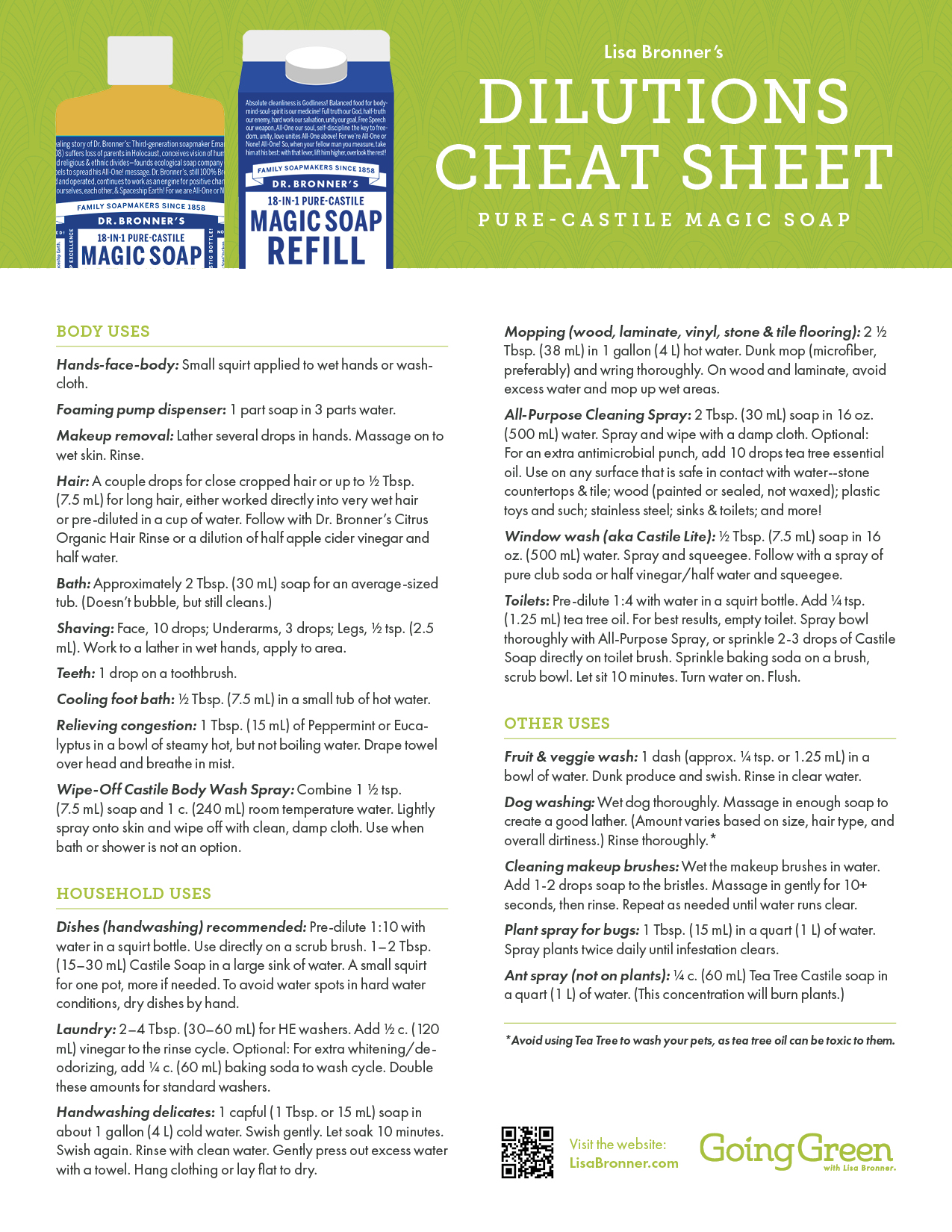
Hi J – Start with a 1:3 dilution for a foamer and adjust it to your liking.
[…] https://www.lisabronner.com/?p=228 […]
Hi,
I’m a new customer, searching for a natural all-around soap for the household. What type of Dr. Bronner’s soap works best for babies?
Hi Amy – I am very sorry for overlooking your question from February. Your baby might not be so much of a baby at this point. However, if it still helfpul, I recommend some of the milder essential oils such as the Almond Castile or Lavender Castile. You could also use the unscented Baby Mild, but I like a little bit of scent.
[…] https://www.lisabronner.com/?p=228 […]
Time for true confessions, folks. It is February 9, 2017, and I have missed several months of comments for the simple reasons that things went a little crazy around here. I very much apologize. I am tackling them now for the sake of those faithful and new readers who might actually read them all. I am going to start with the most recent. Bear with me.
WILL PEPPERMINT CASTILLE SOAP STRIP HAIR OF PURE HENNA FROM HAIR. WILL IT DAMAGE GREY-WHITE 4C BLACK HAIR.
my experience with dr bronner as a one stop shop soap was in 1991 on a 2 week trip to guatemala! my hair – normally straight and fine, was a frizzaster. I couldn’t stand to brush my teeth, etc. I now use it regularly as a body soap, and frequently make diy home cleaning products. but, your blog is enlightening me. but i have to know and please do tell, what do you use to highlight your perfect highlights? : )
I have tried going natural, chamomile, tea, henna, etc.,, and sadly reverted back to chemicals. What do you use ? your hair is gorgeous! thank you!
I was wondering if I can use this soap around my Virginia area?
Hi Stacey – Yes, the soap is fine on all sensitive skins, although the different essential oils can make it more intense. Many customers find that the peppermint soap is a bit “zingy”, but others like that affect. You may want to try the almond, citrus, or lavender to start with.
[…] https://www.lisabronner.com/?p=228 […]
Hi !! How do I dilute the soap for a body wash? Do I have to dilute the product or can I use it right from the bottle on sensitive skin? An will diluting the soap make the product go bad faster ?
Hi Lisa!
I can’t say how wonderful it is to have found your blog. Lots of awesome information here. I used to use the lavender Castile soap years ago, but got away from using it on a regular basis. Your blog inspired me to go back to using it on a more regular basis! Thank you for that. I saw the Bronner’s documentary quite a while ago and remember seeing your father demonstrate how he bathed out of a bowl of warm water with Castile soap. With the colder months coming ahead, I’d much at her prefer to bathe this way, but cannot find any information on how much he used to dilute the water.
Welcome back, Melina! My grandfather would say “a squirt” in a sinkful of water. I realize that’s not terribly accurate, but I would guess that in a couple quarts of water, maybe 1-2 teaspoons? That’s a guess, so feel free to tweak it to what works best for you.
I’m going camping at Philmont Scout ranch and I will not have access to a shower for two weeks. I thought I read I could dilute a couple of drops of your soap into a 1 gallon zip lock mix it up and use the solution to give myself a sponge bath. Is that true?
I’d really appreciate your help! I switched to Dr. Bronner’s castile soap 2 weeks ago. I didn’t dilute the soap, and used 1/2 ACV, 1/2 water as a rinse and it was a dream! (My hair is mid-back length). Then, the second washing two days later I noticed this waxy feel when putting the soap in my hair. The ACV took it out a little, but my hair was tangled. Since then, my hair has gotten harder and harder to comb out. With each wash it gets worse (I wash every 2-3 days). I bought the Shikakai Conditioning Hair Rinse, along with a wide tooth shower comb. I brush from the bottom and work my way up.
Today I diluted the soap in half a cup of water, rinsed with water, then used the Shikakai hair rinse (diluted in a half cup of water) and let that sit in my hair before rinsing out. And it’s awful. I can’t comb out my hair, it’s so tangled. I really want this to work, since the gently nature of the soap is really good for my scalp psoriasis. Many, many, many thanks for your help!!
Hi Lisa,
I’ve started using the castile bar soap to wash my face but I’m missing the scrub aspect that my old washes used to have. Could I possibly mix baking soda with the liquid soap to create a face/body scrub? If so, how should I mix them?
I have struggled with yeast infections under folds of my skin for the past several years. The doctor prescribed a cream for me but it only seems to be a temporary fix. Will the castile tea tree liquid soap help me with this problem? ( I have read that tea tree oil is a good product to kill bacteria)
Hello Lisa
I just started to use Pure liquid Castile soap -Tea tree- for my hair. I decided to try it because my hair gets very greasy very quickly. I use white vinegar to rinse (4TB sp + 1 cup of water) I just pour it diluted vinegar on my hair and do not rinse anymore with water. I just was wandering if vinegar is the right product to rinse my hair or better to use something else like lemon juice or apple sider or citric acid and dilute it my self or I have to bye Dr. Bronner Hair Rinse product. Please kindly advice to me what is the best way for the hair rinse after Castile soap
Thanks
Nadia
Hello Lisa – I just became aware of your products and purchased the Peppermint Castile Liquid Soap. I am a guy with short hair and, besides using the soap as a body wash, I have also used the soap a couple of times as my shampoo with good results. I read where you recommend I add the Citrus Hair Rinse to this routine. One question I have is if the Hair Rinse has a citrus fragrance to it? One reason I was so excited about the various uses of the Peppermint soap was that I could get rid of all the various fragrances I had in my previous routine – I would hate to have that great Peppermint scent working in the shower, and then having to add a Citrus scent to it. Can you please let me know if the Citrus Hair Rinse has this different scent or if it is fragrance free? If it does have a scent, would it be possible in the future to create something similar, but with the Peppermint scent? Thanks so much!!!
After a year of using soaps like Dr. Bronner’s to wash my hair, I’ve found that lye soap in general leaves a film and makes my hair look and feel like straw. It used to be straight and shiny, but now it’s dull and, as I’ve already stated, straw-like. I have religiously used a citric acid rinse to “balance out the pH”, as no-pooers are fond of saying, and while these rinses do de-tangle my hair, they don’t prevent the film or the gradual stripping of oil.
Recently, I came across a blog article (http://blog.kanelstrand.com/2014/01/baking-soda-destroyed-my-hair.html) detailing how continually raising your hair’s pH (as with alkaline soaps or baking soda) and then suddenly dropping the pH with ACV or citric acid rinses actually weakens your hair, making it susceptible to damage, and strips your scalp of its natural oils.
I, of course, went on a mission to find alternatives to soap and baking soda, eventually settling on rye flour after reading about another blogger’s experience with it (http://myhealthygreenfamily.com/blog/wordpress/homemade-shampoo-with-rye-flour-natural-pro-v-for-thick-shiny-healthy-hair/). So far, using rye flour has made my hair less straw-like, but every time I use it I feel like I’m wasting food. And I can’t help but think that there must be a way for cosmetic chemists to come up with a formula for non-soap/non-detergent shampoo that uses sustainable, non-toxic ingredients which stay within 4 to 5.5 on the pH scale to complement your hair and scalp’s natural pH.
I have frequently bought Dr. Bronner’s soaps in the past because of the quality of the ingredients your company uses, and I am posting here in the hopes that your company would seriously consider developing the type of shampoo I described. Dr. Bronner’s has already expanded slightly beyond traditional castile soaps, and I think that a non-soap shampoo would be a great addition/replacement for the citrus rinse (which isn’t stocked in most local stores anyway). If this theoretical shampoo also costs less than $5 for 8 oz, you will have destroyed the shampoo competition, especially in the all-natural category.
Furthermore, this theoretical shampoo might be a good alternative to the Dr. Bronner’s Baby-Mild soaps because it takes the guess-work out of dilution ratios. If you think about it, Baby-Mild can’t really be considered mild if the pH is still 8-9 like the other Bronner soaps. Just a thought. I hope you guys take this into consideration because I’m sure I’m not the only one waiting very anxiously (and slightly impatiently) for the true holy grail of shampoos.
If you’ve read this far, thank you. I’m exhausted.
I use dr bronners for everything, shampoo, bodywash, etc. I ues the unscented. I don’t notice if my hair is like straw, but then again im a guy and I dont’ really care. I just don’t like toxic shit in my body and Dr.Bronners prevents that. You seem to be exhausting yourself, just wash your hair and move on.
Seriously? You “feel like you’re wasting food”? That is your excuse for not using rye flour for shampoo? I cannot take a single thing else you write seriously after reading that. Do you know how much waste goes into shampoo? Rye flour is cheap and a whole bag could last a year. This is seriously really …. laughable.
Hello Lisa,
I first wanted to tell you that I love all the Dr Bronner soap products. They are such high quality products! My family is a fan for life!
I am currently trying to remove a bad henna color from my hair and Dr Bronner’s Castile soaps were recommended to help remove this henna stain. Have you talked to anyone that can verify this? I haven’t used it yet. But I really need to find a solution to this problem. I was told to wash my hair a couple of times with the Dr Bronners soaps before attempting to color correct my hair with any other hair dyes. I was told that it would help strip the henna stain from my hair.
If you have any insight into this issue – please let me know. I haven’t attempted this color correction yet. But I trust Dr Bronner products will do the trick!
Thanks!
I have a 4 month old that I am looking for soap for him. I really want to use organic everything for him. Would I have to dilute the baby soap?
Hi, I just started using Dr. Bronner’s Tea Tree Oil bar soap for my body and hair as I have developed hand eczema and thought this would help, it has. I am 69 years old and have naturally curly hair, going grey, that I have been fighting with for 69 years!! I tried the bar soap in my hair and it did an amazing job of stripping away the build up. Now I am using it for both shampoo and body wash which will be very good when we travel. I live in Alberta Canada and I am having a hard time finding the hair rinse, do you have any suggestions where I might be able to buy it? Right now I am using a cream leave in conditioner and 2 drops of Orofluido Oil on soaking wet hair and it is working. I would like to try the rinse though. I am washing my hair twice a week and when I don’t wash I just rinse my hair in the shower then do the leave in and oil routine which works wonderfully. I am so glad I found Dr. Bronner’s.
So I’ve been using the baby mild soap undiluted and the hair rinse for about a month now, and I’m starting to get a bunch of white flakes on my scalp. It doesn’t FEEL dry but my hair doesn’t exactly feel greasy, either. It still has great texture to it. I’m not sure what to do. More soap? More hair rinse? My scalp isn’t itchy or anything. Really odd that its just super flaky. Or should I be using one of the other soaps? I have no idea. Any help would be appreciated.
Hi Lisa Bronner,
I just wanted to ask if you had any alternatives that I can use instead of Dr. Bronners. Reason why is because my skin has gotten even more acne than usual since I started using this product, I think it might be an allergic reaction but I am not sure.
Hi,
I wonder do any one have a same PBS as me, I use the Castile soap as a shampoo, and after I washed my hair, my hair is look clean but feel dirty with a very thick layer on top, when I comb my hair it seem a hard job for me, and It make my comb dirty….. I don’t think I do not rinse well… But this pbs is keep on and off to me and I really don’t know why! Anyone can help?
I do use ACV n Dr. bronner conditioner
What is Natural almond fragrance?
I recently switched to using Dr. Bronner’s soap and Hair Rinse on my hair and its awesome! I wash every other day (although I may try waiting longer) and I no longer get the itchy feeling on my scalp that I used to if I didn’t wash every day. Also, I asked my husband last night if my scalp looked greasy, just because I’m paranoid, and he said it didn’t. Which is awesome because my hair feels so soft right up by my scalp and that is totally not something I’m used to (hence the reason I was worried about it being greasy). Not only that, but my normal dishwater blonde color looks much less dingy now than it used to. I was previously using an organic shampoo and conditioner and it just felt like it wasn’t rinsing out all the way and it took FOREVER to comb out my long hair. Now my hair feels thick and my scalp feels clean, and it only takes 5 min or less to comb out my hair (halfway down my back, so a reasonable amount of time) and I notice less tangles that I did before. Great products! So glad I made the switch!
Hi Julia – You definitely have been down a long road! I hope you have now entered a simpler time, even if there is a steep learning curve on all the DIY natural stuff. If you have color added to your hair, either by a full color treatment or low lights, Dr. Bronner’s may not be the best option. I have had readers say that it doesn’t seem to remove their color, though, so you could try it out. Another option is to use a henna dye, which is a different process and isn’t as affected by alkaline hair washes. In order to look for a color-safe shampoo, you can check out the Environmental Working Group’s cosmetics safety database and see what they say, http://www.cosmeticsdatabase.com.
All the best,
Lisa
Hi Lisa,
Within the past 2 months I have switched all of my household cleaners, laundry detergent to all homemade. I was diagnosed with fibromyalgia last year. Nothing in the medical field has worked for me as far as meds go. So, I have been researching on my own. From cleaning products, to homemade meals and beauty products ( shampoo, body wash, lotions etc). While in my research, using castile soap for laundry detergent was recommend by one of my favorite bloggers. I decided to look further into Dr. Bronner’s products.
I recently purchased the liquid tea tree castile soap due to reading the reviews about how well it has worked on those with oily skin…That’s me, as well! I am 44, and still have breakouts from time to time. It all began when I was around 12/13. It’s been a constant struggle, so much so that when I was around 15, my parents,seemed out a well known dermatologist. After trying every medicine from tropical creams to prescription meds, the dermatologist decided my situation was unique and well…ACUTANE was prescribed. I had to go in monthly for blood work to make sure my cholesterol wasn’t high. It was awful. I learned a few years back that it could affect fertility. I, however am extremely lucky. I have 4 beautiful children, all older now….21,20,19 and 17 (3 boys, 1 girl). However, I never new the risk this drug could cause. So, at the age of 44, I did finally found something that worked (dermaquest) however, this doesn’t go along with the new all natural changes I am making. I am day 3 into using the tea tree castile soap. So far so good! I just ordered the lavender coconut oil and the citrus rinse.
I also have been using the tea tree castle soap for my hair HOWEVER, I just read it’s not good for color treated hair. I decided to contact my hair dresser… I can’t remember if I have low lights or color. I also read that some people have found just using the citrus hair rinse as a shampoo worked for them. I will give it a try. I REALLY want to use the castile tea tree soap. Do you have any recommendations if this doesn’t work for me?
Thanks for all of the great info! It’s really helpful when learning about ALL NATURAL products. P.S…. I absolutely LOVE coconut oil. Too!
Julia
Awesome, Jaime! Thanks for sharing your tips!
I figured it out. I just diluted both products A LOT like 1:8 and it worked!!! No more greasiness just soft and shiny!!!!!
I’ve read the questions and answers regarding ‘greasy’ hair and how it isn’t really greasy but imbalanced. I have been using the Dr. Bonner baby mild shampoo for over a month. Before I saw your blog I mixed it with a tsp of grape seed oil (from a website recommendation) with no conditioner, then I used it with apple cider vinegar. Then I finally got on your website and bought the citrus rinse and ditched the grape seed oil. I have been using just the diluted soap with the citrus rinse for about 2 weeks. I usually wash my hair daily, but occasionally skip a day. The reason I am still wondering if it is actually greasy is because if I add my homemade dry shampoo -baking soda, corn starch and cocoa (I have brown hair) it isn’t ‘greasy’ anymore. I bought the gallon Dr Bonners because I use it in my kid’s bath and for cleaning around the house so I’d prefer not to switch types unless you think that is my problem.
Sounds great, Christina! I love that coconut oil.
I began using the tea tree soap on my skin and peppermint in my hair and i noticed my hair and skin were really dry at first (or should i say straw like and itchy skin). So I started moisturizing with the coconut oil after my shower and i actually take a little bit of the coconut oil and rub it into the ends of my hair. once a week i use it as a deep conditioner. It helps a lot.
Hi Carrie – Yes! My very next post will be on that exact subject. As long as you don’t also have lowlighting, where streaks of color are added back in, the castile or Shikakai soaps are great options for you.
Hi Jennifer – This is different for everyone and depends on your hair length, your lifestyle, your hair type and more. I go every two days, but I have long, fairly dry hair. I have friends with really short hair who wash it every day. Go with what works for you and gives you the hair you like. Your method sounds great! And no kidding about that hard water in Arizona! I thought I had hard water in California until I travelled one state east!
All the best,
Lisa
I haven’t read through the entire thread of posts here, so if this has already been asked, I apologize. I use Dr Bronners Tea Tree in a foam pump diluted with water for hand soap and was wondering if this would work for shampoo as well? I was going to try it with the unscented/baby Dr Bronners. What are your thoughts on this? And thanks!
i also wanted to give my method of cleaning my hair. it took me a good two weeks to be wean off the store shampoo/conditioner. i keep a measuring cup and my measuring spoon in the shower with me. i mix a cup of water and 1/2 tbsp and pour over my scalp. i clean my scalp with my fingertips. see, the scalp is what we really want to clean. after i have a good lather, i rinse and rinse and rinse. then i mix two capfuls of the citrus rinse in a cup of water and pour it over my scalp and hair and work its way down my hair (to seal the cuticle) and i rinse and rinse and rinse. have to make sure it’s ALL out. today i had to use the rinse two times but the second time i rinsed i only used one capful in a cup of water and tonight my hair looks and feels amazing. i have to remember NOT to touch it so much because i don’t want it greasy and dirty but i cant help it. i have very very long hair and very hard water here in Arizona. also i have completely given up store cleaners and only use Bronners for EVERYTHING. amazing product. best advice: wean off the store bought shampoo. you will not regret it.
i don’t remember reading this: but how many times a week should i clean my hair? i workout everyday and sweat so i don’t want to over dry my hair but i don”t want it stinky either.
Hi Lisa,
Can I use the lavender castile soap (or anything else) on highlighted hair?
Hi Brenda – Unfortunately, the pH of soap (any soap) does not work well with chemically treated hair. Soap is alkaline and cannot be made otherwise. In general, products that are considered “color safe” are acidic. The alkalinity in the soap causes the follicles on the hair strands to open, allowing the stored color to seep out.
All the best,
Lisa
Hi Lisa,
I have just purchased the unscented baby liquid soap and your citrus rinse to use as shampoo for my scalp psoriasis after using a hot hemp oil treatment. I have highlights, lowlights, and a Brazilian Blowout (chemicals) in my hair. Are your products unsafe for color and chemical treated hair?
Hi Janet – You are welcome to use the rinse without prediluting it. Make sure your hair is really drippy wet when you apply it, and the water in your hair will dilute it. This is what I do when my plastic cup disappears and it works fine.
All the best,
Lisa
Hi Lisa. I wash my hair with Lavender or Rose castile liquid and follow with the cItrus Hair Rinse. I wash my hair first and leave the rinse in until done with my shower, as you said worked well for you. What I’m wondering is whether I need to bother with diluting the hair rinse – or would I get the same benefits if using just a drop or two of it straight from the bottle? I have short hair, natural color [no processing damage] and in the past needed only a very small amount [pea-sized or so] if I did need to use a regular conditioner. Thanks for your advice.
Hi Jessica – Thank you for sharing your transition to soap instead of shampoo. I’m glad you stuck with it.
All the best,
Lisa
I have finally figured out a solution to my previous hair troubles! I have fine, extremely straight hair. I had tried the shikakai soap alone (left it too tangly and dry) and I have tried the shikakai soap with the rinse (I had a permanent wet look). I have figured out that I have to rub Dr Bronners bar soap on my hair until I work up a big lather (just keep rubbing on hair and it will create a ton of lather). I lathered up my scalp all the way to my ends. Then I fully rinse my hair with warm/hot water. It will feel squeaky. I then add a very small amount (maybe 1 tablespoon) of the Dr B rinse to a lot of water (1000ml/4cups) in a big jug and pour it over my head. I find when I heavily dilute it, it takes away some of the “wet look”. I then rinse again very thoroughly with warm/hot water. I do find it takes much longer to dry, even with a hair drier but when it eventually does it does not look wet. The back of my head near the scalp sometimes tends to feel a bit greasy when I run my hands through my hair, but when I use a mirror to look, it does not appear greasy or wet. I had almost given up on natural hair care and went back to “poo” until I got this method right. I hope my experience can help others. Keep experimenting! Something will work eventually.
My Dr. B rinse is goopy and clumps together. Is this normal or has my batch ‘gone off’?
Love Dr. B’s by the way!
Hi Jessica – I know it’s very unconventional, but yes, it is dark brown and can be clumpy especially if it is cold. You can dilute it in warm water. Let me know if I can be of further help.
All the best,
Lisa
Hi Lauren – Yes, you can. The only two considerations is that then you’d be pouring a cold solution over your head, which might be uncomfortable, and if the mixture were to sit for a couple of weeks, the preservative (vitamin E) would not be enough to keep it preserved. If you want to pre-mix a couple of days’ worth, though, go for it.
All the best,
Lisa
Can you “pre-mix” the rinse with water?
I very much apologize for my delay in responding here. I hope my responses are still of help to someone.
Sherry – If it’s your first time with the castile soap, you might find it drying. However, mixing it with an oil will only cause the soap molecules to bond with the oil, and take away their cleansing ability. It is better to use a light moisturizer afterwards until you skin gets used to the castile, which it will.
Elizabeth – Many people have found good results with apple cider vinegar as a rinse. It depends on your hair type, the condition its in, and what style you’re looking for.
Thanks, Betty! Glad to have you on board!
Elyse – I’m so glad to hear it! I agree that the Shikakai requires a bit more than the castile, but try lathering it up in your hands before applying. I find that I’m able to go further with a smaller amount that way.
Kelsey – The pH needs to be balanced each time you use the soap. The soap is causing the follicles on your hair strands to stick straight out. Oddly, this creates the oily feeling. If you don’t get those smoothed down each time you use the soap, they’re going to give you that look. I’ve never done the baking soda and ACV method, so I’m not sure if it’s the same scenario, but it might be. As far as a transition period, mine was about two weeks til I didn’t have to think about it, but I noticed that my hair grew stronger and stronger over the next year as damage caused by conventional products was replaced by new growth.
Jamie – My post on the topic of shampooing with Dr. Bronner’s might be particularly helpful: http://lisa.drbronner.com/?p=256. ACV works for some people but the Dr. Bronner’s Citrus Hair Rinse is formulated specifically for the pH of the castile and Shikakai soaps. I do recommend that you try that. What you are describing sounds like a pH imbalance. The other issue that those of us with long hair face is that it takes a very long time for the damage caused by conventional products to be replaced. Conventional products coat over the damage, so we don’t see it as readily. However, the castile soap strips it all off, exposing it in all its damaged glory.
Nicole – Whatever you use for a rinse needs to be acidic in order to balance out the alkaline pH of the soap. Since citrus isn’t an option, a vinegar is the next best thing. The Dr. Bronner’s Hair Creme are not acidic either.
Kerrie – We suggest diluting the Hair Rinse because it can be so thick coming out of the bottle and hard to work through your hair. You might end up feeling like you need to use more than is really necessary. Also, occasionally someone finds the lemon juice in the Rinse a little stinging to the scalp. I don’t have this problem, and I occasionally don’t dilute the rinse and use it straight. It is fine to do so, if you prefer.
Jan – You are exactly right. This is another factor as well which an acidic rinse will clear up.
Jan #2 (same Jan?) – Wonderful to hear! Thank you so much for sharing your experience with us!
Nicole – Welcome to Dr. Bronner’s! If you’re using the Shikakai without the Hair Rinse, what you’re noticing is not residue, but rather a pH imbalance. The alkalinity of the soap causes the follicles on your hair to stick out all up and down the strands of your hair. These cause your hair to feel sticky and look dull, like there is a coating on it. Some people have success with apple cider vineger (ACV) as an acidic rinse, but Dr. Bronner’s has also formulated a Citrus Hair Rinse that works great. It is unconventional in both ingredients and appearance, but it works great. I wrote more about shampooing with Dr. Bronner’s here: http://lisa.drbronner.com/?p=256.
Let me know if I can be of further help!
All the best,
Lisa
I’m a new Dr. Bronner costumer and I was wondering Do you know how to dilute shikakai tea tree soap for hair use? I’ve been using it the past couple of days and it leaves a bunch of residue in my hair.
Dr. Bronner’s, I am your biggest fan!
I first used your bar soap over five years ago…and when I rinsed ‘squeaky clean’ and experienced the bliss of no residue on my skin – which made my skin soft and no longer flaky dry – I became a user for life. Then I began washing my hair with it for the same squeaky clean. Two years ago I took it a step further to use it with a sprinkle of baking soda as a tooth cleaner. Did it do the same for my teeth? You bet! Smooth, shiny teeth without any fluoride or chemicals. Not only was there no icky-feeling film build-up during 24 hours after brushing, over the next 10 months of use the tartar at the base of my two bottom front teeth was gone. My teeth are clean, white and cavity-free. Just started my six year old grandson on this as well after noticing that, although the toothpaste his mother sent was fluoride-free, it contained sodium-laurel-sulfate. There was no complaint of the taste as with his tube paste, so he brushed longer and even loved the suds, calling himself Santa! LOL Thank you for a truly wonderful organic product.
Most sincerely, Jan