

Even if I were wearing a blindfold and earplugs, there are certain places I could go and know exactly where I was. My childhood home always smelled of coffee. My grandfather’s house contained an intoxicating blend of every essential oil in his castile soaps from peppermint to lavender to rose, plus a dash of his mineral seasonings and supplements.
Scent. It’s the most evocative, penetrating, and enigmatic of our five senses. We have scent associations we’re not even aware of, until suddenly we’re transported somewhere we hadn’t been a moment before. Tell me I’m not the only one to experience this!
Philippe Soguel is a fragrance connoisseur and founder of essential oil producer Distillerie Bleu Provence in Nyons, France. “With perfumes, with scents, we have this memory which is very powerful,” says Philippe. “It is often said that when we close our eyes, it’s a little bit like music: the smells, the perfumes, we can relive the moment.”
We bring scents into our homes for a number of reasons. Often, we are trying to capture the sensation of a pleasant place we’ve been or moment we’ve lived or a dream we hold close—a day at the beach, a walk in the woods, even a relationship. Other times, we are trying to make an impression or convey an attitude to ourselves or guests—clean, bright, energetic. And admittedly, sometimes we are trying to cover up something unpleasant that we haven’t wanted to or been able to deal with.
Table of contents:
- Fragrance hazards to watch out for
- Eliminate odors naturally
- Ways to make your house smell good naturally
- Guide to candle selection
- Harness the power of scent wisely
Fragrance hazards to watch out for
Because of the power and allure of fragrance, you can find it in every type of consumer product from the obvious like plug-in air fresheners, sprays, and candles, to cleaning and laundry products, and on to the more unexpected such as trash bags and cat litter. Few of these scents derive from essential oils or other close-to-nature sources. Most are synthetically produced. When all of these fragrance emissions converge in our living spaces, they add up to quite a potent chemical burden in the air and then in our lungs as we breathe in the spaces.
There are a number of problems fragrances pose. Here are some of the reasons I take special note of the composition and source of scents in both body care and household products:
- Synthetic scents are more common than plant-based essential oils for a variety of reasons, including that they are usually less expensive, easier to come by, and are less variable than scents sourced from nature. However, these synthetics may not be bio-compatible, meaning that they do not interact well with our bodily systems. Our immune systems may react as though to a threat, or in the absence of being able to break down the compounds, our bodies may store them—a phenomenon called bio-accumulation. Bio-accumulation can burden the function of many bodily organs and systems.
- Ingredients in fragrance are often not disclosed on product labels. Considered trade secrets, fragrance blends are exempt from most required ingredient disclosure, so even if you take the time to read ingredient lists, you only would find vague terms like “fragrance” or “parfum.” There are over 3000 chemicals that are used in fragrance blends, according to the International Fragrance Association. Many of these ingredients pose known hazards to human health.
- There are no standards for establishing the safety of fragrance ingredients. While a goodly number of fragrance ingredients have been connected to health maladies, there is no follow-up regulatory framework to keep such ingredients out of fragrance blends.
- Scent is difficult to sustain over time. They easily fade or alter the longer a product sits. Therefore, manufacturers use powerful fixatives to prolong the scent life. One category of these fixatives is phthalates (pronounced tha-lates), whose known hormone-disrupting effects are linked to infertility, reproductive misdevelopment, neurological maladies, and other infirmities. Gina Solomon, M.D., M.P.H., Senior Scientist, NRDC, studied phthalates in air fresheners. They found phthalates in 86% of tested products, 25% of which with phthalate levels over 100 ppm. One product soared over 7300 ppm. “Consumers should be aware that the pretty label and sweet scent may mask something much less pleasant,” Solomon cautioned. Solomon further encouraged individuals to open windows to flush out indoor air and to eliminate the sources of bad smells rather than seek to cover them up.
- We all breathe. If there is a scent in the air, that means there are compounds in the air producing those scents. If we are in the space, we are going to draw them into our lungs, which readily absorb elements from the air. These are ingredients we cannot avoid, which is why we need to take particular care to ensure they come from healthy sources.
While scent can be beautiful and even evoke pleasant feelings, they can harbor problems.
Get rid of the bad smells
Covering up bad smells doesn’t work. It really doesn’t. I know it can be gross to deal with a source of bad smells, but it just has to be done. Every other attempt to make your home smell good will fail if you do not get rid of bad smells first. Bringing your air back to neutral before trying to enhance it is the first step in creating a pleasant-smelling home.
Eliminate sources of bad odor
Bad smells can hide in loads of household nooks: trash cans, garbage disposals, fridges, dishcloths, laundry hampers, shoes, pet bedding, pets, over-watered plants, overripe fruit. (To clarify, I am NOT advocating getting rid of pets—as I sit here with one cat on my lap, one dog at my feet, and three others lurking about—but sometimes they need a spa-day, even at home, with a good brushing, washing, and drying.) Track down the source of musty or sour smells and deal with them as the first step to a great smelling home. Wash the laundry, run sliced lemons through the garbage disposal, wash the pets and their bedding, and handle whatever else needs handling. Strap on your courage and get to it.
Open your windows
Change out the air. This is a great step to eliminating stale air and freshening the scent of your home. Even after the source of a bad smell is gone, the scent can linger in the air, trapped within our well-sealed and insulated houses. When I get home from a trip, and my house has been closed up for a week or so, I always notice that the air smells stale. Opening windows and flushing out the air works wonders. If opening windows isn’t possible, use an air purifier.
Neutralize odors with sachets of unscented activated charcoal
Sometimes there are areas that just always seem to trap and accumulate the smells. Maybe it’s because of the circulation of people or air. Activated charcoal absorbs all manner of smells for a fragrance-free home. Get the unscented ones that come in sachets. Place them in inconspicuous spots. I place these in closets, near litter boxes, and in areas where my pets congregate. If they get “full,” set them out in bright sunlight to deodorize naturally, and they’ll be ready to go once again.
How to make your house smell good naturally
Now that we’ve done the dirty work of getting rid of the bad smells, let’s move on to the fun stuff! These are all ways that I have used to make my house smell fantastic, without adding a toxic chemical burden to my air. This leans into my concept of GIY, or Green-It-Yourself, which means taking control of the compounds you’re bringing into your life by making them yourself.
I get excited about all of these and am always finding new scent combinations. And many of these tactics also make delightful homemade gifts.
Simmering potpourri (aka a simmer pot)
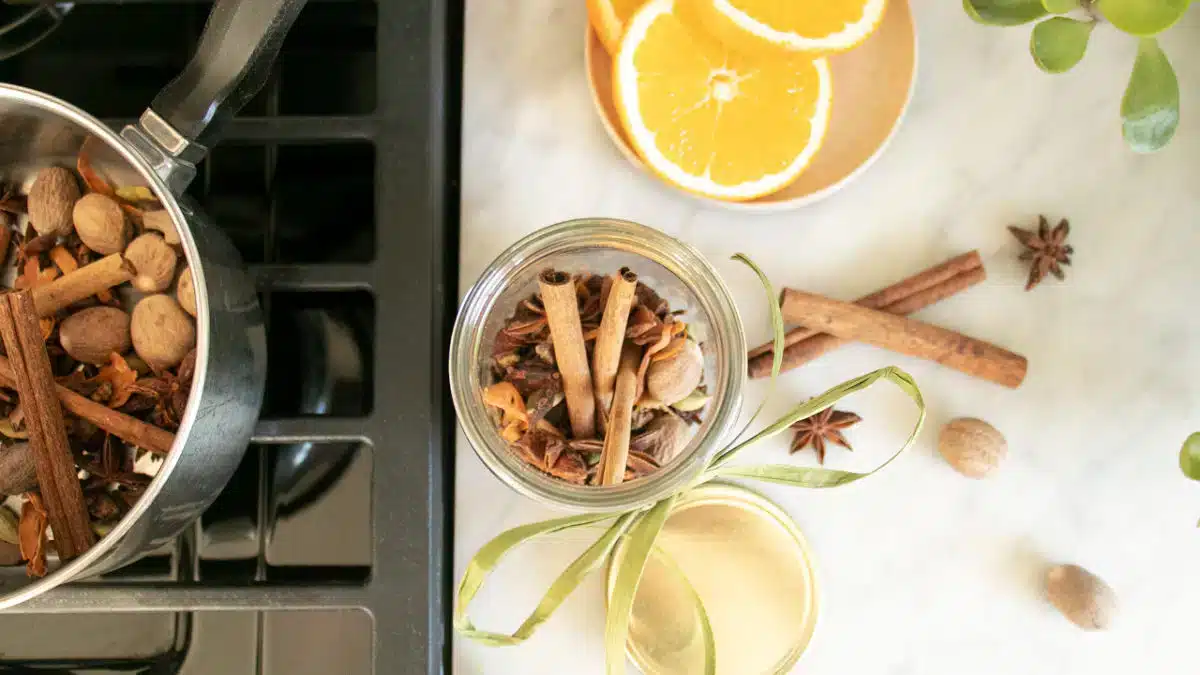
This is my favorite way to scent my house with coziness and comfort. A stovetop potpourri or simmer pot scents your home by gently simmering fragrant fruits and spice in water, creating a lovely and customized non-toxic air freshener. At first, I used a pot on my stove, but later I acquired a small sauce-sized slow-cooker, which I was more comfortable leaving on and unattended. Another option is a tea pot warmer—something that can keep a pot or bowl at a low heat over time.
Materials:
- Mini slow-cooker, small saucepan, or bowl over a tea warmer
- Assortment of aromatic botanicals and essential oils – see combinations below
- Water
How to make a simmer pot: Combine aromatics in the slow cooker, pot, or bowl. Fill with enough water to cover the ingredients. Bring to a boil, then reduce heat to a simmer. The steam carries the scent into the air. To jump-start the steam, I heat water in my kettle and pour it over the aromatics. As the water evaporates throughout the day, keep adding more. Some combinations, especially whole spices that don’t break down quickly, can be reheated over several days.
Some of my favorite simmering potpourri combinations:
- Coffee & Spice – Used coffee grounds, cinnamon stick, 1 tsp. (5 mL) cinnamon, cloves, star anise
- Cranberry Orange – Sliced oranges, cranberries, cloves & cinnamon sticks
- Herbal Lemon – Lemon peel, rosemary, bay leaves
- Apple Cinnamon – Thick slices of apples, cinnamon stick, cloves
For a gift, choose dried options such as herbs and spices and package in a glass jar with directions. Garnish with a cinnamon stick or sprig of rosemary tied with twine around the top.
Homemade Air Freshener Spray

Since air fresheners are the most concentrated forms of fragrance, often with a heavy burden of chemical compounds, this is a great GIY alternative.
Materials:
- Fine misting spray bottle, either new or a repurposed Dr. Bronner’s Organic Hand Sanitizer Bottle
- Vodka or other unscented clear alcohol (Not isopropyl alcohol, which is denatured with a bitter tasting additive.)
- Pure essential oils – undiluted, organic when available. Alternatively, herbs, citrus peels, or spices
How to make a low-tox room spray with essential oil: Fill spray bottle with vodka and then add essential oils of your choice. For a 4 oz. (120 mL) bottle, start by adding 20 drops of your desired essential oils. Increase amount to desired intensity. Essential oils vary in intensity, so the amount will differ for each type. To use herbs, citrus peels, or spices, fill a glass jar with vodka and aromatics, and let it sit for several weeks. Strain the liquid and transfer to a spray bottle.
Some of my favorite non-toxic room spray combinations:
- Sweet orange oil, with a bit of cinnamon.
- Lavender, peppermint, or a combo of lemon & eucalyptus.
- If blending your own is daunting, there are many ready-made blends of essential oils to explore.
Dr. Bronner’s Organic Hand Sanitizer in Peppermint or Lavender also makes an excellent Room Spray.
For a gift: Make a collection of three Room Sprays. Tie together with a reusable ribbon.
Cinnamon applesauce ornaments/magnets
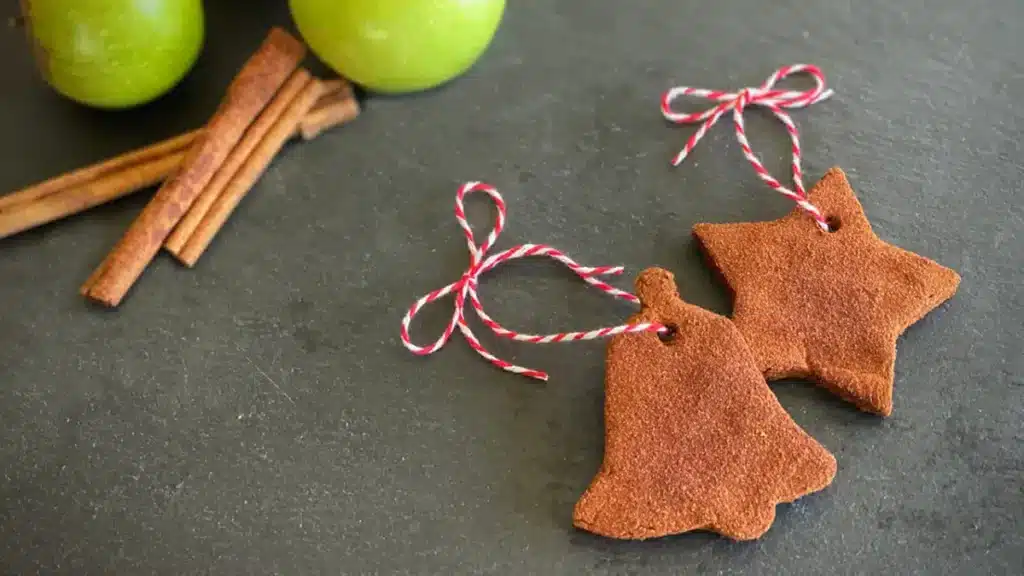
These simple, no-bake cinnamon ornaments are such fun to create, and they make use of any quirky or cute cookie cutters. These ornaments aren’t just for the holidays either! Hang them on furniture knobs, hooks, or bulletin boards to make any room smell like fresh apple pie for months.
Materials:
- Applesauce
- Cinnamon
- Cookie cutter or small glass
- Straw & twine OR magnet & hot glue
How to make cinnamon-scented ornaments or magnets: Combine equal amounts of applesauce and cinnamon to form a stiff dough. Start with 1 cup (250 mL) of each. Depending on the liquidity of the applesauce, you will need to adjust the amount of cinnamon. Roll dough to 1/4″ thickness. Cut with 3″ cookie cutters. For an ornament, use a straw to make a hole for twine. Skip this step to make a fridge magnet.
Place on wire rack to dry for 3-4 days, or alternately, bake in 200°F oven for 3 hours. Turn off oven and leave door closed until cool. Once fully cool, thread with festive twine or use hot glue to affix a magnet to the back. If scent fades, sprinkle a few drops of cinnamon essential oil on it to reactivate.
For a gift: Use the ornament variation and tie on to a gift as a topper, or make a variety of shapes to package together. Makes a great gift for a host!
Aromatic herbal bouquets

The best part about this is that it can involve a nature walk, too, which is a delight!
Materials:
- Aromatic plants that dry well, such as eucalyptus, lavender, sage, rosemary
- Twine
How to make an aromatic herb bouquet: Cut a handful of the plants. Tie tightly together with twine wrapped around the stems several times. Release the oils by rolling the plant with a rolling pin or similar crush the leaves slightly. Hang the bundle upside down in a shower or elsewhere. If the bundle begins to turn brown or mold, it’s time to replace.
- Eucalyptus bunch in shower – don’t let mold
- Kitchen herbs – rosemary, thyme, sage – hang where air moves (by window, near vent, people pass by)
For a gift: Tie a hefty bunch with natural twine and present with a flourish.
Orange pomander (aka a clove-studded orange)

I’m going a little Dickensian here, but I think these are as beautiful visually as they are entrancing to smell. An orange pomander is an orange studded with whole cloves.
Materials:
- Fresh, pretty orange with fully intact and healthy skin. Do not wash it, as that will remove the skin’s natural resilience and longevity
- Lots of whole cloves
- Toothpick or other sharp pointed tool
- Optional: ribbon or twine
How to make an orange pomander: With the toothpick, pierce the skin with a design all over the orange. You could start with a series of lines from one pole to the other, or dancing swirls, or a diamond pattern. Place a whole clove in each hole. To hang, wrap the ribbon or twine around the pomander and tie tightly, leaving long tails to form a loop for hanging. To extend the life of your orange pomander, dry it by placing is on a shelf, turning daily, or in a paper bag until dry (a few weeks).
For a gift: There is nothing extra to be done to make this gift-worthy. They are beautiful as is. Place in a mesh bag to let the scent through.
Homemade cleaning products, scented your way

Admittedly, this idea isn’t picturesque, but it is practical. Another great way to scent your air healthfully is to make your own cleaning products and add essential oils. My GIY All-Purpose Spray, GIY Glass Cleaner, and GIY Scouring Powder are great ways to start. In the picture above, I was getting my neighbor all set up with a green cleaning kit of her own!
Materials:
- Two 16 oz. (500 mL) spray bottles
- 16 oz. (500 mL) shaker jar or mason jar with slotted lid
- Water
- Dr. Bronner’s Magic Soap or Sal Suds
- Distilled white vinegar
- Baking soda
- Pure essential oils
How to make these GIY cleaning products: GIY All-Purpose Spray: Fill one spray bottle with water. Add either 2 Tbsp. (30 mL) Magic Soap or ½ tsp. (7 mL) Sal Suds. Intensify the scent of the essential oils already present by adding your own customized choices. Start with 10 drops and increase to desired intensity.
GIY Glass Cleaner: Fill the other spray bottle halfway with water and the rest with vinegar. Add 20 drops of desired essential oils.
GIY Scouring Powder: Combine 2 cups (500 mL) baking soda with 20 drops essential oil in a bowl. Mix with a fork to break up lumps and combine. Add more essential oils to your desired intensity. Transfer to shaker jar.
For a gift: For that special person in your life who would appreciate a green cleaning kit, get them started with these three basics. (Always keep in mind my mom’s lesson to me: gifts should not suggest a need to improve! So pick your recipient wisely.)
Carpet deodorizing powder

Full disclosure: this is the same as the scouring powder I just described. The trick is how you use it. As a baking soda carpet deodorizer, this can perk up the air in big rooms by scenting the biggest horizontal surface: the floor! Take note, this will only freshen the carpet, not clean it. This will not cover-up the scent of anything icky–ok I’ll just say it: This will not cover up the scent of cat pee or anything like it. For that, see the section above about getting rid of the source of bad smells. But this will perk things up if the carpet is just a touch stale.
Materials:
- The GIY Scouring Powder described above
- A broom
- A vacuum with a HEPA filter
How to deodorize carpet with baking soda: Test this first on an inconspicuous bit of carpet and vacuum out to be sure the vacuum can fully extract the powder. Sprinkle the carpet with the scented Scouring Powder. Use the broom to brush it in. Let it sit for 20 minutes. Thoroughly vacuum the powder out. Be sure to empty the vacuum bag or collection chamber afterwards.
Another vacuuming trick that can add a nice scent to the air is to put fresh cinnamon sticks in the collection chamber of the vacuum, if possible. As you run the vacuum, the passing air will waft the cinnamon scent through your rooms.
For a gift: See my note above. It would be a very good friend who would appreciate the gift of homemade carpet deodorizing powder, but for that person who has everything? It might be just the thing.
Fragrant baked goods without the last-minute mess

This is the oldest trick in the book: to make your house smell fantastic, bake something delicious. My mom was famous for her pumpkin muffins, which she would make in big batches and freeze. This perfectly scented the air with sugar and spice and everything nice (waaaaaay before the pumpkin-spice craze). I happen to be a particularly messy cook, so I was thrilled to learn this unbaked freeze-ahead trick, which doesn’t mess up the kitchen right before guests arrive.
Materials:
- Ingredients for your favorite cookie recipe
- Baking sheet or cutting board
- Freezer
Freeze-ahead deliciousness: A week or two ahead of time, mix up a batch of cookie dough—chocolate chip is a failsafe or I personally love molasses crinkles. Shape the dough as though you were going to bake them, and place on a baking sheet or cutting board. Place them close together but not touching. Instead of baking, pop them in the freezer. Once frozen, store the shaped dough in an airtight container. Shortly before guests arrive, arrange frozen dough on baking sheets and bake from frozen. Oh my, now I want fresh-baked cookies.
For a gift: This is one of my favorite gifts to give. You do have to be able to keep them frozen though. I once gave my brother a container of ready-to-bake cookie dough—I think they were oatmeal scotchies. I was really pleased with that gift.
Guide to candle selection
Candles are another popular go-to for scenting the air, but as with all scented products, there is the potential for some hazards. It matters what sort of wax the candle is made from, what is used to scent it, and even the wick material. And always open a window while burning a candle for ventilation.
* Best wax: beeswax, soy, or coconut wax, as opposed to paraffin or similar petroleum-based wax.
* Scent: Essential oils or other fragrance certified by a reputable third-party organization like the Environmental Working Group, as opposed to a synthetic fragrance that contains any of the fragrance hazards mentioned above.
* Wick: Made from cotton, wood, or hemp, as opposed to having a metal center. (Lead wicks have been banned in the U.S. since 2003 but check for zinc or other metals.)
* Dyes/Colorants: Opt for natural colors. Dyes and other colorants are unnecessary to the scent of the candle and may release problematic compounds into the air.
Harness the power of scent wisely
Earlier this year, I was walking through the streets of Nyons, France on a blazingly hot summer day when I was unexpectedly flooded with memories of my mom’s famous spaghetti sauce. I remembered the comfort of gathering with my family–and inevitably a few friends who heard it was spaghetti night–around our much-loved kitchen table. In that moment, I even recalled that heartbreaking time my freshly served pile of spaghetti slipped off my plate and landed with an soggy splat on the floor as I had been carrying it inattentively to my place. What transported me back to this vivid memory? The oregano that was being distilled at the nearby Distillerie Bleu Provence the morning of my visit.
Scents allow us to travel through space and time, transporting us to places we have been, moments we have lived, even people we have known. It is beautiful thing to harness that potential in our homes, but it must be done with care.







Wow, what a very thorough and informative article! Thank you. I wanted to share that those cinnamon apple ornaments are the best. I had made some many years ago, and when I take them out of our attic to decorate the tree, would you believe they still have a scent! I’m definitely going to make more of those real soon, such fun to make too. I like the air fresheners recipe too, the sweet orange oil and cinnamon combo sounds awesome.
Thanks, J! I’m with you – those ornaments are so festive and fun! Thanks for your kind words on the article. I’m glad you liked it!
I’m so glad to hear it, J! The Cinnamon Applesauce ornaments are a very happy scent for me, too. If they ever do fade, you can put a drop of essential oil (clove is perfect) on them–not too much or else they’ll soften, but a drop or so on the hardened ornament works great!